
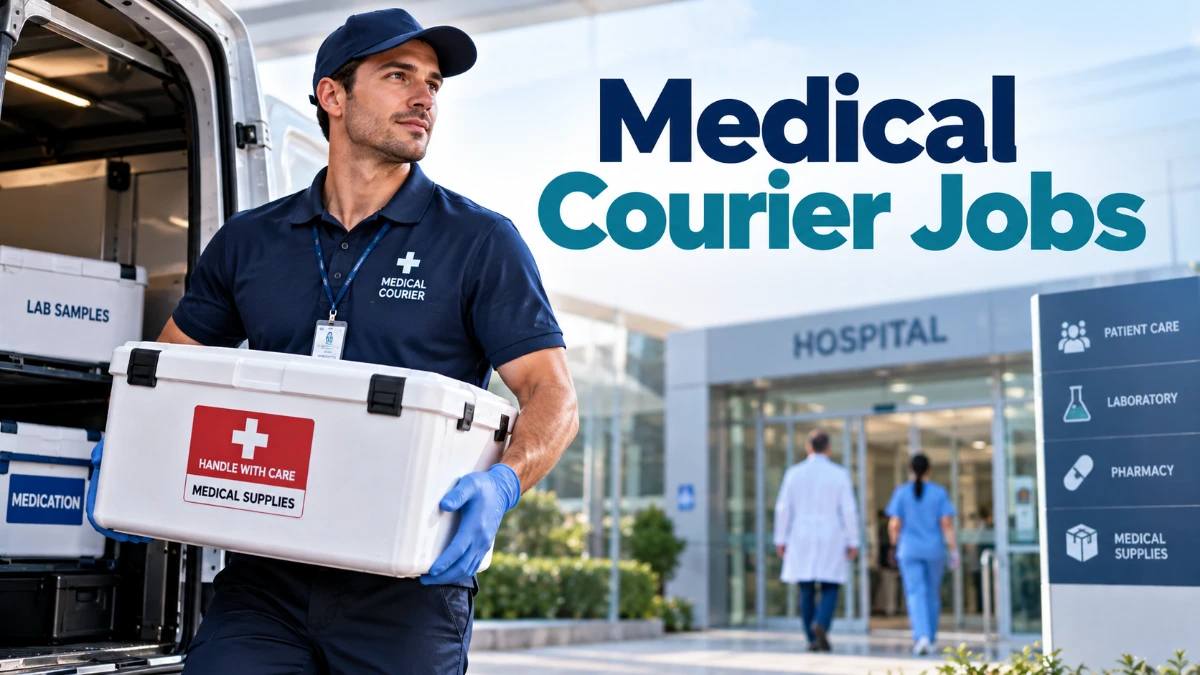
Medical deliveries may look similar to ordinary courier work, but the level of responsibility can be significantly greater. A driver may transport laboratory specimens, medications, medical records, supplies, equipment, or other healthcare materials that need to reach the correct destination safely and on schedule.
Medical courier jobs can appeal to people who enjoy driving, working independently, following precise procedures, and contributing to healthcare without working in a traditional clinical role. Depending on the employer and assignment, positions may be full-time, part-time, route-based, on-call, or independent-contractor opportunities.
This complete guide explains medical courier duties, pay, requirements, qualifications, training, employee and contractor arrangements, safety procedures, job-search strategies, and how to become a medical courier.
Quick Answer: What Are Medical Courier Jobs?
Medical courier jobs involve transporting healthcare-related materials such as laboratory specimens, medications, documents, medical supplies, and equipment between approved locations.
Most positions require a valid driver’s license, dependable transportation or access to a company vehicle, attention to detail, punctuality, and the ability to follow delivery, privacy, safety, and chain-of-custody procedures.
Medical courier work generally does not involve diagnosing patients or providing clinical treatment. The courier’s primary responsibility is secure, accurate, and timely transportation.
Read more: Medical Courier Jobs
What Is a Medical Courier?
A medical courier is a delivery professional who transports healthcare-related materials between medical facilities and other authorized destinations.
Routes may connect:
- Hospitals
- Clinical laboratories
- Doctor’s offices
- Pharmacies
- Dental offices
- Medical supply facilities
- Research facilities
- Blood collection locations
- Healthcare distribution centers
- Patients or approved delivery destinations
The exact cargo depends on the company and route.
Some drivers primarily transport packaged medical supplies. Others handle laboratory specimens, pharmaceuticals, documents, testing materials, or sensitive healthcare shipments that require more detailed procedures.
This is one reason medical courier work should not be treated as ordinary parcel delivery with a different job title.
What Do Medical Couriers Deliver?
The contents of a medical courier vehicle can vary significantly depending on the employer.
Common deliveries may include:
- Laboratory specimens
- Properly packaged blood samples
- Medications
- Medical supplies
- Patient documents
- Small medical devices
- Dental materials
- Diagnostic testing materials
- Healthcare equipment
- Research materials
- Pharmacy orders
- Other approved healthcare packages
Couriers generally do not diagnose patients, interpret laboratory results, administer medication, or provide medical treatment.
Their role is transportation, tracking, and custody.
For example, a specimen courier may collect packaged samples from several clinics and deliver them to a central laboratory. A medical delivery driver may instead distribute equipment or supplies from a warehouse to healthcare facilities.
Typical Medical Courier Duties and Responsibilities
Driving is only one part of the job.
Common medical courier duties can include:
- Following assigned pickup and delivery routes
- Meeting required delivery windows
- Verifying pickup and drop-off information
- Scanning packages or specimen containers
- Recording pickup and delivery times
- Maintaining chain-of-custody records
- Protecting packages from damage or unauthorized access
- Following employer handling procedures
- Maintaining required transportation conditions
- Communicating delays to dispatchers
- Using GPS and courier applications
- Obtaining signatures or electronic proof of delivery
- Keeping the delivery vehicle clean and dependable
- Reporting damaged or leaking packages
- Following privacy and confidentiality procedures
- Documenting unsuccessful delivery attempts
- Securing materials while they are inside the vehicle
Accuracy is important because errors involving healthcare shipments may have more serious consequences than mistakes involving ordinary parcels.
Why Chain of Custody Matters
Chain of custody refers to documentation showing who possessed or handled an item during different stages of transportation.
Not every healthcare delivery requires the same level of documentation, but accurate tracking may be especially important for laboratory specimens and other sensitive materials.
A courier may need to record:
- Pickup location
- Pickup time
- Package or specimen identifier
- Destination
- Courier identification
- Delivery time
- Receiving party
- Electronic confirmation or signature
Drivers should follow the exact procedure established by their employer, laboratory, pharmacy, hospital, or client.
They should not create their own undocumented handling system.
Medical Specimen Transportation and Safety
Anyone considering medical specimen courier jobs should understand that specimen transportation may involve specific safety procedures.
The Occupational Safety and Health Administration’s Bloodborne Pathogens Standard addresses occupational exposure to blood and other potentially infectious materials.
Specimens must be packaged and transported using appropriate containers designed to prevent leakage during handling and transportation.
Depending on the material and circumstances, labeling, secondary containment, employee training, exposure-control procedures, and personal protective equipment may also be relevant.
Couriers assigned to specimen routes should know what to do if a package:
- Leaks
- Breaks
- Appears damaged
- Is incorrectly labeled
- Is improperly sealed
- Appears contaminated
A courier should not casually open or repackage a questionable specimen.
Instead, the driver should follow employer procedures and contact the appropriate dispatcher, supervisor, laboratory, or safety representative when required.
Medical Courier Requirements
There is no single nationwide checklist that applies to every medical courier job.
Requirements vary according to employer, vehicle type, route, cargo, location, and employment arrangement.
However, several qualifications are common.
Valid Driver’s License
Most driving positions require a valid driver’s license appropriate for the vehicle being used.
Employers may also review:
- Driving history
- Moving violations
- License status
- Accident history
A strong driving record can improve an applicant’s chances of being hired.
Reliable Transportation
Some employers provide a company car, van, or delivery vehicle.
Others, particularly companies hiring independent contractors, may require couriers to use their own vehicles.
If a personal vehicle is required, calculate your actual operating expenses before accepting the route.
Appropriate Vehicle Insurance
Drivers using their own cars should confirm whether their insurance coverage is appropriate for delivery activity.
Ordinary personal auto insurance may not necessarily provide every type of protection needed when a vehicle is being used commercially.
Applicants should verify coverage directly with their insurer rather than making assumptions.
Background Screening
Some medical courier employers conduct:
- Criminal background checks
- Driving-record checks
- Drug testing
- Employment verification
- Other pre-employment screening
Requirements differ by organization and applicable law.
Smartphone and Mobile Data
Many modern courier operations depend heavily on mobile technology.
Drivers may use smartphones for:
- Navigation
- Route assignments
- Dispatching
- Barcode scanning
- Delivery confirmation
- Status updates
- Photography where permitted
- Electronic signatures
- Communication with dispatch
Reliable mobile service may therefore be essential.
Physical Ability
Some medical courier jobs require frequent walking, entering and exiting a vehicle, climbing stairs, or carrying containers and supply packages.
Applicants should check each job posting for specific lifting or physical requirements.
Do Medical Couriers Need a Degree?
Usually not.
For the broader courier-and-messenger occupation, a high school diploma or equivalent is commonly considered sufficient entry-level education, and short-term on-the-job training is typical.
A college degree is generally not required for ordinary medical courier work.
This makes the occupation accessible to applicants coming from:
- Delivery driving
- Warehouse work
- Transportation
- Logistics
- Customer service
- Dispatch
- Healthcare support roles
- Route driving
However, low educational barriers do not mean the job should be treated casually.
Employers may value reliability, punctuality, safe driving, accurate documentation, confidentiality, and attention to detail more than advanced academic qualifications.
Do Medical Couriers Need HIPAA Training?
HIPAA is frequently mentioned in healthcare transportation job advertisements, but there is no single universal “medical courier HIPAA certification” required for every courier job.
Responsibilities depend on the organization, contractual relationship, information being transported, and the courier’s actual access to protected health information.
In some situations, a courier may act primarily as a transportation conduit and have only limited or incidental access to protected health information.
Other healthcare delivery arrangements may involve broader privacy or confidentiality requirements.
Applicants should follow the employer’s specific privacy, security, and training procedures.
Avoid purchasing random online “HIPAA certifications” simply because a job advertisement mentions HIPAA unless the employer specifically requires a particular program.
Couriers should also avoid casually disclosing:
- Patient names
- Addresses
- Package labels
- Medical documents
- Delivery information
- Photographs of healthcare shipments
- Details about pickup or delivery locations
How Much Do Medical Courier Jobs Pay?
There is no single official nationwide salary specifically covering every type of medical courier job.
The broader courier-and-messenger occupation provides a useful benchmark.
According to 2025 BLS occupational data, couriers and messengers had median annual earnings of approximately $39,200.
Industry-specific BLS data also show median compensation of approximately $19.27 per hour, or about $40,090 annually, for couriers and messengers working within the Couriers and Messengers industry.
These figures should be treated as general benchmarks rather than guaranteed medical courier salaries.
Actual medical courier pay can vary based on:
- State and city
- Employer
- Experience
- Employee versus contractor classification
- Route length
- Number of stops
- Delivery urgency
- Vehicle requirements
- Night shifts
- Weekend work
- On-call responsibilities
- Mileage reimbursement
- Overtime
- Specialized handling duties
Some medical courier jobs may pay more or less than broader industry averages.
Employee vs. Independent Contractor Medical Courier Jobs
One of the most important things to understand before accepting a position is whether you will work as an employee or independent contractor.
Employee Medical Courier
Employees may receive:
- Hourly pay
- Salary
- Overtime eligibility
- Employer-provided vehicles
- Fuel reimbursement
- Training
- Equipment
- Benefits
Exact arrangements vary by employer.
Independent Contractor Medical Courier
Contractors may be paid:
- Per route
- Per stop
- Per mile
- Per shift
- Through another negotiated payment system
However, contractors may also be responsible for expenses such as:
- Fuel
- Maintenance
- Tires
- Repairs
- Vehicle depreciation
- Insurance
- Mobile service
- Tolls
- Parking
- Self-employment-related taxes where applicable
Therefore, contractors should compare net earnings, not just gross route pay.
A route paying $200 may sound attractive, but that figure means little until you know how many miles and hours the route requires.
How to Calculate Whether a Courier Route Is Worth It
Before accepting a contractor route, estimate:
Gross route pay − fuel − tolls − parking − maintenance − insurance allocation − vehicle depreciation − other expenses = estimated net route earnings
Then divide expected net earnings by the total time required.
For example, if a route pays $200 but takes eight hours and requires substantial driving expenses, the effective earnings may be much lower than the headline amount suggests.
Also determine whether you are compensated for:
- Waiting time
- Return trips
- Failed delivery attempts
- Extra stops
- Route delays
- Tolls
- Parking
What Is a Typical Medical Courier Workday Like?
A courier’s workday depends heavily on the type of route.
A scheduled route may begin at a laboratory, pharmacy, warehouse, hospital, or dispatch center.
The driver may receive assignments, inspect necessary equipment, confirm the route, and begin visiting pickup locations.
At each stop, the courier may:
- Verify the pickup.
- Scan or record packages.
- Confirm identification details.
- Record the pickup time.
- Secure the shipment.
- Continue to the next stop.
- Deliver items to the authorized destination.
- Obtain proof of delivery.
Some medical couriers have predictable recurring routes.
Others handle stat, urgent, or on-demand assignments that change throughout the shift.
Because hospitals, pharmacies, and laboratories often operate outside ordinary business hours, some courier positions involve:
- Early mornings
- Evenings
- Overnight shifts
- Weekends
- Holidays
- On-call schedules
Skills That Make a Good Medical Courier
Strong couriers need more than driving ability.
Time Management
Medical deliveries can be time-sensitive.
Drivers must manage routes efficiently while still following traffic laws and safe-driving practices.
Attention to Detail
Small errors involving addresses, package identifiers, timestamps, or delivery confirmations may create significant problems.
Dependability
Employers need couriers who consistently arrive for scheduled routes.
Reliability can be particularly important when laboratories or healthcare facilities depend on recurring pickups.
Communication
Couriers may communicate with:
- Dispatchers
- Laboratory employees
- Reception staff
- Pharmacists
- Nurses
- Security personnel
- Warehouse staff
- Healthcare administrators
Professional communication helps prevent delays and misunderstandings.
Technology Skills
Couriers should be comfortable with:
- GPS navigation
- Delivery apps
- Barcode scanners
- Electronic signatures
- Dispatch systems
- Smartphones
Calm Problem-Solving
Unexpected situations can include:
- Heavy traffic
- Severe weather
- Closed entrances
- Incorrect addresses
- Missing recipients
- Vehicle problems
- Route delays
A good courier knows when a routine issue can be resolved independently and when dispatch should be contacted.
How to Become a Medical Courier
The path into medical courier work is relatively straightforward compared with many healthcare occupations.
Step 1: Meet Basic Driving Requirements
Start with a valid driver’s license and a driving record that meets employer requirements.
If you will use your own vehicle, ensure it is dependable and appropriately insured.
Step 2: Build Relevant Experience
Previous medical experience is not always required.
Useful transferable experience includes:
- Package delivery
- Food delivery
- Warehouse work
- Logistics
- Route driving
- Customer service
- Dispatch
- Pharmacy delivery
- Healthcare support work
Step 3: Learn Basic Delivery Procedures
Become familiar with concepts such as:
- Proof of delivery
- Chain of custody
- Package security
- Confidentiality
- Route documentation
- Time-sensitive transport
Employer-specific procedures should always take priority.
Step 4: Create a Courier-Focused Resume
Highlight:
- Safe driving
- Reliable attendance
- Route experience
- GPS skills
- Delivery applications
- Documentation accuracy
- Customer service
- Warehouse or logistics experience
Step 5: Search Multiple Job Titles
Do not search only for “medical courier jobs.”
Related titles include:
- Medical delivery driver
- Laboratory courier
- Specimen courier
- Healthcare courier
- Pharmacy delivery driver
- Route courier
- Lab driver
- Medical logistics driver
- Medical specimen driver
Step 6: Compare Compensation Carefully
Determine:
- Employee or contractor status
- Vehicle arrangement
- Mileage reimbursement
- Fuel expenses
- Benefits
- Route length
- Schedule
- Insurance requirements
- Waiting-time policies
Step 7: Complete Required Training
Once hired, complete all employer-required safety, privacy, dispatch, route, and material-handling training before working independently.
Can You Get Medical Courier Jobs With No Experience?
Yes, some employers hire entry-level applicants without previous medical courier experience.
Candidates may still need a strong driving record, reliable attendance, good communication, and the ability to follow detailed procedures.
Applicants with previous delivery or logistics experience may have an advantage, but relevant transferable skills can also come from:
- Warehouse jobs
- Retail
- Customer service
- Rideshare driving
- Pharmacy work
- Healthcare support
- Dispatch roles
Job seekers should avoid claiming medical or safety certifications they have not actually completed.
How to Find Medical Courier Jobs
Searching strategically can produce better results than relying on one keyword.
Search using terms such as:
- Medical courier jobs
- Medical courier jobs near me
- Medical delivery driver
- Lab courier jobs
- Laboratory courier
- Specimen courier
- Healthcare courier
- Pharmacy delivery driver
- Route courier
- Medical logistics driver
Potential employers include:
- Diagnostic laboratories
- Hospitals
- Pharmacies
- Specialty courier companies
- Healthcare logistics companies
- Medical supply distributors
- Research organizations
- Transportation contractors
Check major job boards as well as individual employer career pages.
How to Apply Successfully
A medical courier resume should emphasize skills relevant to transportation, accuracy, reliability, and customer interaction.
Useful qualifications to highlight include:
- Strong driving history
- Reliable attendance
- Delivery experience
- Route-management experience
- GPS proficiency
- Delivery applications
- Documentation
- Customer service
- Safe material handling
- Warehouse experience
- Healthcare experience where applicable
Keep the resume clear and factual.
Never claim certifications, licenses, medical knowledge, or previous work experience you do not have.
Questions to Ask Before Accepting a Medical Courier Job
Before accepting an offer, ask:
- Am I an employee or independent contractor?
- Is compensation hourly, per mile, per stop, or per route?
- Who provides the vehicle?
- Is mileage reimbursed?
- Who pays for fuel?
- Are tolls and parking reimbursed?
- What insurance is required?
- What training will be provided?
- What materials will I transport?
- Are nights, weekends, holidays, or on-call shifts required?
- Is waiting time compensated?
- What happens when the route takes longer than expected?
These questions can reveal whether an apparently attractive offer actually provides reasonable compensation.
Watch Out for Medical Courier Job Scams
Job seekers should be cautious when searching online.
Possible warning signs include:
- Large upfront fees
- Guaranteed unusually high earnings
- Vague company information
- Suspicious messaging-only interviews
- Requests for sensitive financial information too early
- Requests to deposit a check and purchase equipment
- Pressure to send money before starting
- Recruiters using unrelated email domains
- Job listings with unclear employer identities
Research the employer independently.
Whenever possible, verify that the job appears on the company’s official career page or that the recruiter is communicating through legitimate company channels.
Remember that a job can be legitimate and still have a poor compensation structure.
Scam prevention and financial evaluation are two separate issues.
Advantages and Disadvantages of Medical Courier Jobs
Medical courier work can be attractive, but it is not ideal for everyone.
Potential Advantages
- Relatively accessible entry requirements
- Independent work
- Limited desk time
- Predictable routes in some positions
- Healthcare-related work without a clinical degree
- Full-time opportunities
- Part-time opportunities
- Contractor opportunities
- Transferable logistics experience
Potential Disadvantages
- Significant driving
- Traffic delays
- Weather exposure
- Strict delivery deadlines
- Vehicle expenses for contractors
- Early or late shifts
- Weekend work
- Repetitive routes
- Documentation requirements
- Responsibility for sensitive materials
Understanding both sides before accepting a job can reduce unpleasant surprises later.
Medical Courier Career Outlook
Medical couriers do not currently have their own separate BLS occupational forecast, so broader courier-and-messenger data are the most useful public benchmark.
BLS projections indicate that employment for couriers and messengers is expected to grow by approximately 8% between 2025 and 2035, from about 228,900 jobs in 2025, adding roughly 18,200 jobs.
BLS classifies this projected growth as much faster than average.
However, these numbers apply to the overall courier-and-messenger occupation and should not be interpreted as a forecast specifically for medical courier jobs.
Is Medical Courier Work a Good Career?
Medical courier work can be a good fit for people who value independence, enjoy driving, are dependable, and are comfortable following detailed procedures.
The best opportunity is not always the job advertising the highest headline pay.
Compare the entire employment package, including:
- Compensation
- Route length
- Schedule
- Benefits
- Mileage
- Fuel
- Vehicle expenses
- Training
- Workload
- Insurance
- Employment classification
For independent contractors, estimating actual vehicle operating costs is especially important.
For employees, compare benefits, overtime rules, vehicle arrangements, schedule consistency, and opportunities for advancement.
Frequently Asked Questions
What are medical courier jobs?
Medical courier jobs are transportation positions involving healthcare-related items such as laboratory specimens, medications, medical documents, supplies, and equipment. Couriers move these materials between authorized locations while following required delivery, tracking, security, and safety procedures.
Do medical couriers need a college degree?
Usually not. General courier positions commonly require a high school diploma or equivalent rather than a college degree. Individual employers may establish additional requirements.
How much does a medical courier make?
Pay varies by employer, location, route, experience, and employment status. Broader 2025 BLS courier data show median annual earnings around $39,200, while industry-specific data report approximately $19.27 per hour and $40,090 annually for couriers and messengers in the Couriers and Messengers industry.
Can I become a medical courier with no experience?
Yes. Some employers hire entry-level candidates and provide on-the-job training. A good driving record, reliability, attention to detail, navigation ability, and previous delivery or customer-service experience can help.
Do medical couriers use their own cars?
Some do, especially independent contractors. Other employers provide company vehicles. Applicants should verify mileage, fuel, maintenance, insurance, and vehicle requirements before accepting an offer.
What vehicle do I need for medical courier work?
It depends on the route. Some positions can be completed with a reliable passenger vehicle, while medical supply or equipment routes may require a van or larger vehicle.
Are medical couriers employees or independent contractors?
Both arrangements exist. Classification matters because contractors may be responsible for vehicle expenses, insurance, taxes, fuel, and maintenance, while employee positions may offer wages and benefits.
Is transporting medical specimens dangerous?
Specimen transportation can involve occupational safety considerations when blood or other potentially infectious materials are involved. Workers should follow employer training, packaging requirements, exposure-control procedures, and applicable safety standards.
Where can I find medical courier jobs?
Check reputable job boards, laboratories, hospitals, pharmacies, healthcare logistics companies, medical supply distributors, and established courier businesses. Search related titles such as specimen courier, lab courier, and medical delivery driver.
Are medical courier jobs worth it?
They can be worthwhile when compensation, schedule, mileage, route length, vehicle costs, and working conditions make sense for the individual. Contractors should compare estimated net earnings rather than relying only on advertised gross route pay.