
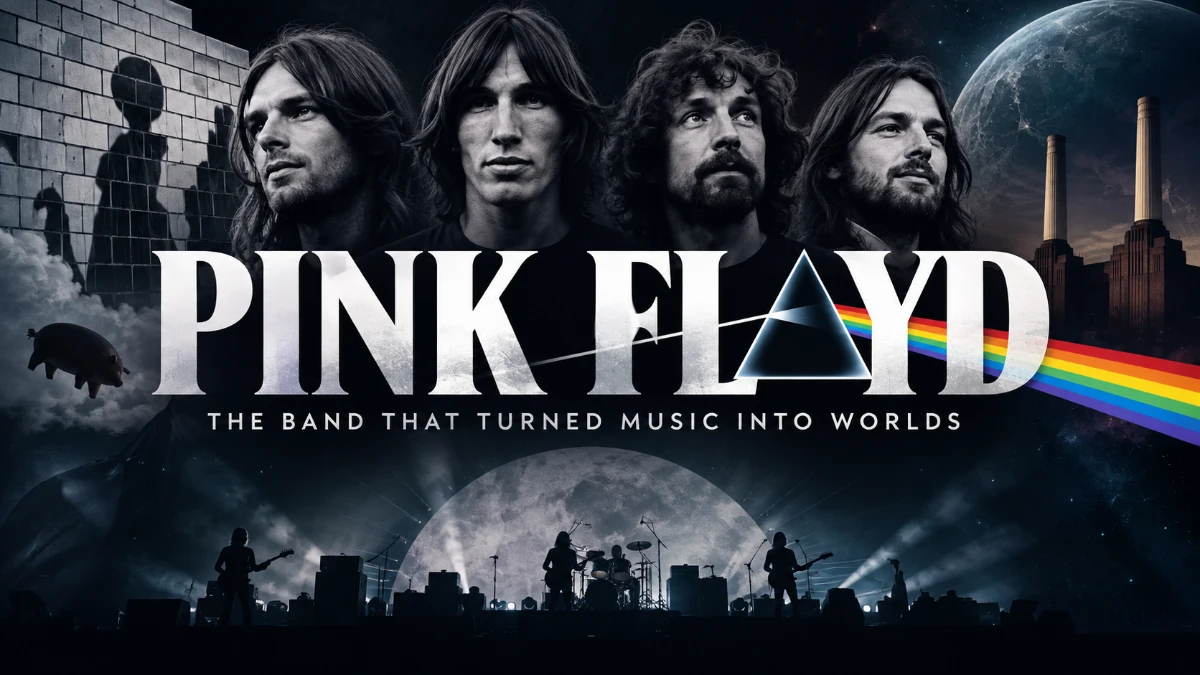
Pink Floyd is one of the most influential rock bands in music history. Known for atmospheric soundscapes, philosophical lyrics, experimental recording techniques, ambitious concept albums, and groundbreaking live performances, the British group helped expand the artistic possibilities of rock music.
From its psychedelic beginnings in 1960s London to landmark albums such as The Dark Side of the Moon, Wish You Were Here, Animals, and The Wall, the band’s music has continued to attract listeners across generations.
This guide explores Pink Floyd’s history, members, albums, most famous songs, musical style, creative periods, lineup changes, reunions, and lasting influence on modern music.
What Is Pink Floyd?
Pink Floyd was an English rock band formed in London in the mid-1960s.
The group was initially associated with the British psychedelic movement before developing into one of the most important progressive and concept-oriented rock bands of the 1970s.
Its best-known members were:
- Syd Barrett – guitar, vocals, songwriting
- Roger Waters – bass, vocals, lyrics
- David Gilmour – guitar, vocals
- Richard Wright – keyboards, vocals
- Nick Mason – drums
The band’s sound changed significantly throughout its career.
Its earliest recordings were surreal, colorful, playful, and psychedelic. Later albums became more atmospheric, philosophical, conceptual, and technically ambitious.
That willingness to evolve became one of the defining characteristics of the group.
Read more: Pink Floyd
Pink Floyd History: How the Band Began
Pink Floyd’s story began in London, where several young musicians met through school, friendships, and the developing British music scene.
Roger Waters, Nick Mason, and Richard Wright had already played together before Syd Barrett became a central figure in the group.
Barrett soon emerged as the band’s principal early creative force.
His songwriting featured imaginative lyrics, unusual guitar ideas, distinctive melodies, and a playful psychedelic personality.
During the mid-1960s, the group became part of London’s underground music scene, where experimental performances, visual projections, improvisation, and psychedelic art were becoming increasingly popular.
Their early concerts were very different from conventional pop performances.
Songs could expand into long instrumental passages while lighting effects and projected visuals created an immersive experience.
This willingness to experiment became a foundation of the band’s identity.
The Syd Barrett Era
Syd Barrett played a crucial role in shaping Pink Floyd‘s earliest sound.
The band’s debut studio album, The Piper at the Gates of Dawn, was released in 1967 and became an important example of British psychedelic rock.
Music from this era often included:
- surreal lyrics
- unusual guitar sounds
- whimsical storytelling
- space-inspired themes
- experimental structures
- playful melodies
Barrett’s creativity gave the group a distinctive personality.
However, his ability to participate consistently in recording sessions and live performances began to decline.
David Gilmour later joined the group, creating a brief period in which both Barrett and Gilmour were members.
Barrett subsequently left the band.
Although his active time with Pink Floyd was relatively short, his influence remained important throughout the group’s history.
Themes involving memory, absence, friendship, loss, and psychological isolation later appeared in some of the band’s most significant work.
David Gilmour and a New Musical Direction
Following Barrett’s departure, David Gilmour became one of the defining figures in Pink Floyd’s sound.
His guitar playing was melodic, spacious, expressive, and emotionally controlled.
Rather than focusing primarily on speed or technical display, Gilmour often emphasized:
- tone
- sustain
- phrasing
- melody
- atmosphere
- emotional expression
The band then entered a transitional period.
Albums such as A Saucerful of Secrets, Ummagumma, Atom Heart Mother, and Meddle demonstrate how the musicians gradually developed a new musical identity.
One of the most important compositions from this period was “Echoes.”
The extended track showed how progressive structures, experimental sound, atmospheric passages, and traditional rock instrumentation could work together.
This musical evolution helped prepare the band for its breakthrough era.
The Dark Side of the Moon
Released in 1973, The Dark Side of the Moon became one of the most important albums in Pink Floyd’s career.
The record explores universal themes including:
- time
- money
- mortality
- conflict
- pressure
- fear
- mental strain
- human existence
Rather than functioning as a simple collection of individual songs, the album creates a connected listening experience.
Sound effects, spoken voices, transitions, recurring musical ideas, and related themes help give the record a unified structure.
Famous tracks include:
- “Time”
- “Money”
- “Us and Them”
- “The Great Gig in the Sky”
- “Brain Damage”
- “Eclipse”
The album demonstrated that ambitious and experimental rock music could also reach a massive mainstream audience.
It remains one of the band’s most recognizable works.
Wish You Were Here
Following the enormous success of The Dark Side of the Moon, the group faced the difficult challenge of creating another major album.
The result was Wish You Were Here, released in 1975.
The album explores themes such as:
- absence
- alienation
- friendship
- loss
- authenticity
- the music industry
- emotional distance
“Shine On You Crazy Diamond” is closely associated with Syd Barrett and became one of the band’s most powerful reflections on memory and absence.
The title track, “Wish You Were Here,” also became one of the group’s best-known songs.
Other tracks, including “Welcome to the Machine” and “Have a Cigar,” examine the commercial side of the music industry.
The album combines emotional songwriting with atmospheric production and extended compositions.
Animals and Social Commentary
Pink Floyd released Animals in 1977.
The record took a darker and more socially critical direction.
Its major compositions use symbolic animals—including dogs, pigs, and sheep—to explore subjects such as social hierarchy, power, inequality, conformity, and control.
The album contains long compositions and a comparatively aggressive musical atmosphere.
The tour supporting Animals also became important to the band’s creative development.
Roger Waters became increasingly uncomfortable with what he perceived as the emotional distance between performers and audiences in enormous stadiums.
Those feelings helped inspire the concept that eventually became The Wall.
The Wall
Released in 1979, The Wall became one of the most famous concept albums in rock history.
The story centers on a character named Pink.
As the narrative develops, painful experiences become metaphorical bricks in an emotional wall that increasingly separates him from other people.
Major themes include:
- childhood trauma
- war
- authoritarian education
- broken relationships
- celebrity
- isolation
- fear
- psychological distress
- emotional detachment
“Another Brick in the Wall, Part 2” became one of the band’s most recognizable songs.
“Comfortably Numb” became another defining track because of its dramatic arrangement, contrasting vocals, emotional atmosphere, and expressive guitar work.
The project extended far beyond the original album.
Concert performances featured ambitious theatrical staging, including the construction of a large physical wall, and the concept was later adapted into a feature film.
Growing Conflict Within the Band
Despite enormous creative success, tensions among the musicians increased.
Roger Waters became increasingly dominant in songwriting, lyrical themes, and conceptual direction.
Richard Wright’s relationship with the group became particularly strained during the production of The Wall.
By the early 1980s, internal disagreements had become increasingly difficult to manage.
The band released The Final Cut in 1983.
The album dealt heavily with war, political disappointment, remembrance, and loss and was largely shaped by Waters.
Roger Waters later left the group.
For many listeners, his departure marked the end of Pink Floyd’s classic era.
The band name, however, continued.
Pink Floyd Without Roger Waters
David Gilmour and Nick Mason continued working under the Pink Floyd name.
Richard Wright later became involved again.
In 1987, the band released A Momentary Lapse of Reason.
Notable songs include:
- “Learning to Fly”
- “On the Turning Away”
- “Sorrow”
This period placed greater emphasis on Gilmour’s guitar playing, vocals, atmospheric production, and large-scale concert sound.
The band then launched a major international tour.
Although the musical character differed from the Waters-led era, many recognizable elements of Pink Floyd’s established sound remained.
The Division Bell
The band released The Division Bell in 1994.
Themes of communication, misunderstanding, relationships, and emotional distance appear throughout the album.
Important tracks include:
- “High Hopes”
- “Keep Talking”
- “Coming Back to Life”
- “What Do You Want from Me”
Richard Wright once again played an important musical role.
The album became particularly popular among listeners who appreciated the atmospheric and melodic qualities of the later Gilmour-led period.
“High Hopes” became one of the best-known songs from this era.
The Endless River
The Endless River was released in 2014.
Much of the material developed from recordings associated with The Division Bell sessions.
The album is primarily instrumental and emphasizes atmosphere, keyboards, guitar textures, and extended musical passages rather than conventional song structures.
The project also served as a tribute to Richard Wright, who died in 2008.
The music demonstrates how important Wright’s keyboard work and harmonic ideas were to the band’s overall sound.
Best Pink Floyd Albums for New Listeners
Pink Floyd’s catalog covers several very different musical periods, so new listeners may wonder where to begin.
These albums provide strong starting points.
The Dark Side of the Moon
This is perhaps the most accessible introduction to the band’s classic sound.
It combines memorable songs, interconnected themes, experimental production, atmospheric music, and philosophical ideas.
Wish You Were Here
A strong choice for listeners interested in emotional songwriting, atmospheric rock, and extended compositions.
The Wall
Recommended for listeners who enjoy narrative concept albums, theatrical rock, memorable songs, and darker psychological themes.
Animals
A good option for listeners who prefer long compositions, social commentary, and a more aggressive musical atmosphere.
Meddle
Meddle provides an excellent introduction to the transitional period between the band’s experimental early years and its classic 1970s output.
The Piper at the Gates of Dawn
This debut album is essential for listeners interested in Syd Barrett and the band’s psychedelic origins.
Most Famous Pink Floyd Songs
Pink Floyd’s catalog contains many songs that continue to attract listeners.
Comfortably Numb
“Comfortably Numb” is one of the band’s most celebrated recordings.
Its combination of dramatic arrangement, contrasting vocals, emotional atmosphere, and expressive guitar playing has made it a lasting fan favorite.
Wish You Were Here
The recognizable acoustic opening and emotional theme give the song an intimate quality compared with many of the band’s larger productions.
Another Brick in the Wall, Part 2
The song became widely recognized for its memorable chorus and criticism of oppressive education.
Time
“Time” explores how years can pass before people fully recognize the limited nature of their lives.
Its opening clocks, percussion, vocals, and guitar solo make it especially distinctive.
Money
“Money” combines an unusual rhythmic approach with a recognizable bass line, sound effects, and lyrics about wealth.
Shine On You Crazy Diamond
This extended composition is strongly associated with Syd Barrett.
It remains one of the clearest examples of Pink Floyd’s ability to create gradually developing atmospheric music.
Echoes
“Echoes” represents an important bridge between the band’s experimental early recordings and the sophisticated concept albums that followed.
Pink Floyd Albums in Chronological Order
The band’s principal studio albums are:
- The Piper at the Gates of Dawn – 1967
- A Saucerful of Secrets – 1968
- More – 1969
- Ummagumma – 1969
- Atom Heart Mother – 1970
- Meddle – 1971
- Obscured by Clouds – 1972
- The Dark Side of the Moon – 1973
- Wish You Were Here – 1975
- Animals – 1977
- The Wall – 1979
- The Final Cut – 1983
- A Momentary Lapse of Reason – 1987
- The Division Bell – 1994
- The Endless River – 2014
The catalog documents the band’s evolution from psychedelic experimentation to progressive concept albums and later atmospheric rock.
What Made Pink Floyd’s Sound Different?
Pink Floyd’s music cannot easily be described using a single genre.
Across different periods, its recordings incorporated elements of:
- psychedelic rock
- progressive rock
- experimental music
- blues
- ambient music
- art rock
- hard rock
- electronic music
Studio production was equally important.
The musicians frequently incorporated:
- spoken voices
- clocks
- mechanical sounds
- tape effects
- synthesizers
- environmental recordings
- unusual transitions
- experimental recording techniques
These elements were not merely decorative.
They often contributed directly to the mood, concept, or meaning of a song.
This approach helped Pink Floyd’s albums feel like complete artistic experiences rather than random collections of individual tracks.
Live Shows and Visual Innovation
Pink Floyd’s ambitions extended far beyond recorded music.
The band’s concerts became famous for sophisticated visual and theatrical elements.
Productions eventually incorporated:
- large projection screens
- elaborate lighting
- animation
- surround-style audio
- inflatables
- theatrical sets
- visual storytelling
The Wall concerts became especially famous because a large physical wall was constructed during the performance.
The band’s approach demonstrated how major rock concerts could combine music, film, animation, sound, lighting, and theatrical storytelling.
That multimedia philosophy helped influence the development of modern large-scale concert production.
Did Pink Floyd Ever Reunite?
Yes.
One of the band’s most significant later reunions occurred at Live 8 in London in 2005.
David Gilmour, Roger Waters, Richard Wright, and Nick Mason appeared together on stage.
The event was especially notable because the musicians had spent many years apart.
Syd Barrett died in 2006, while Richard Wright died in 2008.
Their deaths made a complete reunion of the band’s best-known historical lineup impossible.
Influence on Modern Music
Pink Floyd’s influence extends far beyond progressive rock.
Its approach to songwriting, album structure, guitar tone, studio production, live performance, and conceptual storytelling influenced musicians working across many genres.
Elements associated with the band’s work can be found in:
- progressive rock
- alternative rock
- ambient music
- electronic music
- experimental rock
- art rock
- cinematic music
The group also helped popularize the idea that an album could function as a complete artistic statement rather than simply a collection of singles.
Its career demonstrated that ambitious and experimental music could reach a large mainstream audience while maintaining a distinctive creative identity.
Pink Floyd Legacy: Why the Band Still Matters
Pink Floyd continues to attract listeners because many of the subjects explored in its music remain universal.
Its albums examine ideas such as:
- time
- mortality
- loneliness
- money
- power
- relationships
- war
- emotional isolation
- communication
- meaning
These themes are not limited to a particular generation.
The recordings also contain layers of detail that reward repeated listening.
Background voices, environmental sounds, recurring musical themes, production effects, subtle instrumental passages, and conceptual connections may become more noticeable over time.
The combination of emotional depth, experimental production, memorable songwriting, conceptual ambition, and distinctive musicianship helps explain why the band’s catalog continues to attract new audiences.
Frequently Asked Questions
What is Pink Floyd famous for?
Pink Floyd is famous for psychedelic and progressive rock, ambitious concept albums, philosophical lyrics, experimental studio production, atmospheric soundscapes, expressive guitar playing, and elaborate live performances. The Dark Side of the Moon, Wish You Were Here, and The Wall are among the albums most closely associated with the band’s legacy.
Who were the main members of Pink Floyd?
The best-known members were Syd Barrett, Roger Waters, David Gilmour, Richard Wright, and Nick Mason. Barrett was central to the band’s early psychedelic period, while Waters, Gilmour, Wright, and Mason were responsible for much of its classic 1970s work.
When was Pink Floyd formed?
Pink Floyd developed in London during the mid-1960s. Roger Waters, Nick Mason, Richard Wright, and Syd Barrett were central to the early lineup that established the band’s identity and helped it emerge from London’s psychedelic music scene.
Why did Syd Barrett leave Pink Floyd?
Barrett became increasingly unable to participate consistently in live performances and recording sessions. David Gilmour joined during this period, and Barrett eventually left the group. Despite his relatively short time in the band, his creative influence remained significant.
What is Pink Floyd’s most famous album?
The Dark Side of the Moon is generally regarded as Pink Floyd’s most famous album. Released in 1973, it explores themes including time, money, mortality, pressure, conflict, and human existence. The Wall and Wish You Were Here are also among the band’s best-known releases.
What are the most famous Pink Floyd songs?
Some of Pink Floyd’s best-known songs include “Comfortably Numb,” “Wish You Were Here,” “Time,” “Money,” “Another Brick in the Wall, Part 2,” “Shine On You Crazy Diamond,” and “Echoes.”
What is The Wall about?
The Wall follows a character named Pink whose painful experiences gradually become metaphorical bricks in an emotional wall separating him from other people. The album explores childhood trauma, war, education, relationships, celebrity, fear, and psychological isolation.
Why did Roger Waters leave Pink Floyd?
Creative disagreements and personal tensions within the band increased during the late 1970s and early 1980s. Waters eventually left, while David Gilmour and Nick Mason continued under the Pink Floyd name, with Richard Wright later becoming involved again.
What type of music is Pink Floyd?
Pink Floyd is primarily associated with psychedelic and progressive rock. Its music also incorporates elements of experimental music, ambient sound, art rock, blues-influenced guitar, electronic textures, and hard rock.
What is the best Pink Floyd album for beginners?
The Dark Side of the Moon is an excellent starting point because it combines accessible songs, atmospheric production, experimental ideas, philosophical themes, and the band’s classic sound. New listeners can then explore Wish You Were Here, The Wall, Animals, Meddle, and the earlier Syd Barrett material.