
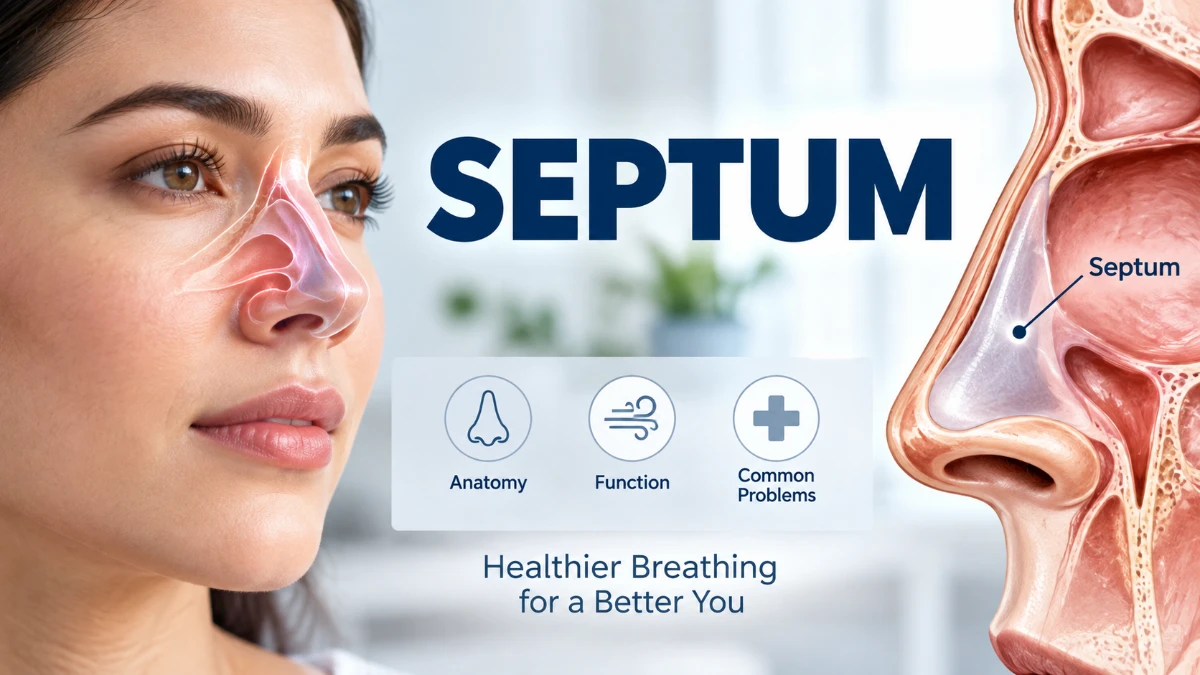
The septum is the internal wall that separates the nose into right and left nasal passages. It is made primarily of cartilage at the front and bone toward the back and plays an important role in nasal structure and airflow.
Although the word “septum” can describe partitions in several parts of the body, people searching for septum most often mean the nasal septum.
A nasal septum does not need to be perfectly straight to function normally. Some degree of deviation is common, and many people with an off-center septum experience no noticeable symptoms. Problems become more important when septal deviation, injury, perforation, or another nasal condition interferes with airflow or causes recurring symptoms.
Possible symptoms include persistent nasal blockage, difficulty breathing through one or both sides of the nose, recurrent nosebleeds, mouth breathing, or disturbed sleep.
This guide explains septum anatomy, function, deviated septum symptoms, causes, diagnosis, treatment, septoplasty, septal perforation, septal injury, recovery, and when to seek medical care.
Medical Disclaimer: This article is for general educational purposes only and is not a substitute for diagnosis, treatment, or advice from a qualified healthcare professional.
What Is a Septum?
A septum is a wall or partition that separates two spaces within the body.
The nasal septum divides the nasal cavity into a right passage and a left passage. It extends from near the front of the nose toward the back of the nasal cavity.
The nasal septum contains both cartilage and bone. Its front portion is largely flexible cartilage, while the deeper portion is primarily bony.
Important structures contributing to the nasal septum include:
- Quadrangular, or septal, cartilage
- Perpendicular plate of the ethmoid bone
- Vomer
- Supporting portions of the maxilla and palatine bones
- Nasal mucosa covering the underlying cartilage and bone
Together, these structures create the internal partition while contributing to the stability and architecture of the nose.
Read more: Septum
Septum Anatomy: What Is the Nasal Septum Made Of?
Understanding septum anatomy helps explain why injury, inflammation, or structural deviation can affect nasal breathing.
Septal Cartilage
The anterior portion of the nasal septum consists mainly of quadrangular cartilage.
Because cartilage has some flexibility, it provides support without being completely rigid. It also contributes to the shape and structural stability of the external nose.
Perpendicular Plate of the Ethmoid Bone
The perpendicular plate of the ethmoid bone forms an important part of the upper bony septum.
The ethmoid is a skull bone located between the eyes and contributes to several structures within the nasal cavity.
Vomer
The vomer forms much of the lower posterior part of the bony nasal septum.
Together with septal cartilage and the perpendicular plate of the ethmoid, it helps form the wall between the nasal passages.
Nasal Mucosa
The cartilage and bone are covered by nasal mucosa, a moist tissue lining with an extensive blood supply.
Blood vessels in the front portion of the septum are particularly vulnerable to irritation and dryness, which is one reason the anterior septum is a frequent site of nosebleeds.
What Does the Septum Do?
The nasal septum performs several important functions.
Divides the Nose Into Two Airways
Its most obvious role is separating the nasal cavity into right and left passages through which air moves during breathing.
Supports the Structure of the Nose
Septal cartilage contributes structural support to the external nose and helps surrounding nasal structures maintain their position.
Influences Nasal Airflow
The position of the septum affects the amount of space available for air to move through each nasal passage.
When the septum is significantly displaced toward one side, the narrower passage may create greater resistance to airflow.
Supports Normal Nasal Function
The nasal cavity helps warm, humidify, and filter inhaled air before it travels farther into the respiratory system.
The septum forms part of the structural pathway through which this airflow occurs.
What Does a Normal Septum Look Like?
A healthy septum does not have to be perfectly straight.
Ideally, it provides enough space on both sides of the nasal cavity for comfortable airflow. Small bends, ridges, or irregularities may be present without creating clinically meaningful problems.
A septal abnormality becomes more relevant when it contributes to symptoms such as:
- Persistent nasal obstruction
- Difficulty breathing through the nose
- Recurrent nosebleeds
- Mouth breathing
- Sleep disturbance
- Significant discomfort
- Problems following nasal trauma
The appearance of a crooked septum alone does not determine whether treatment is needed. Symptoms and their effect on daily life are more important.
What Is a Deviated Septum?
A deviated septum occurs when the nasal septum is displaced away from the midline.
Instead of dividing the nasal passages relatively evenly, the septum may bend or shift toward one side, making one passage smaller than the other.
A mild deviation may cause no symptoms. A more substantial deviation can restrict airflow enough to make breathing difficult through one or both sides of the nose.
According to Mayo Clinic, most deviated septums cause no symptoms, and treatment is generally unnecessary when the deviation is not causing problems.
How Common Is a Deviated Septum?
Septal deviation is very common.
Mayo Clinic has reported that approximately 70% to 80% of people have some degree of septal deviation noticeable during examination, although many deviations are minor and do not cause symptoms.
This distinction is important.
Having an off-center septum does not automatically mean that a person has a medical disorder or needs surgery. Treatment becomes more relevant when the structural abnormality contributes to persistent or troublesome symptoms.
What Causes a Deviated Septum?
A deviated septum may be present from birth or develop following trauma.
Development Before Birth
Some people are born with a septum that developed off-center during fetal development.
Injury During Childbirth
Trauma associated with childbirth can occasionally affect the nasal septum.
Nose or Facial Injury
Injury is another important cause.
Possible examples include:
- Contact sports
- Falls
- Vehicle accidents
- Rough play
- Physical impacts
- Facial trauma
- A broken nose
Mayo Clinic identifies both congenital development and nasal injury as recognized causes of septal deviation.
Changes With Age
The structures of the nose can change over time, so an existing deviation may become more noticeable with aging.
Swelling caused by infection or inflammation may also further narrow an already restricted nasal passage and make symptoms feel worse.
Common Deviated Septum Symptoms
Many people with a deviated septum have few or no symptoms.
When symptoms occur, they may include:
1. Persistent Nasal Blockage
One of the most common complaints is the sensation that one nasal passage is consistently difficult to breathe through.
Some people experience obstruction on both sides.
2. Difficulty Breathing Through the Nose
A narrowed nasal passage can increase airflow resistance.
Difficulty may become more noticeable during:
- Sleep
- Exercise
- Colds
- Respiratory infections
- Allergy flare-ups
3. Recurrent Nosebleeds
Altered airflow and dryness of the septal surface may increase the likelihood of nosebleeds in some people.
4. Noisy Breathing During Sleep
Restricted nasal airflow may contribute to noisy nighttime breathing.
However, snoring and noisy breathing have many possible causes and should not automatically be attributed to the nasal septum.
5. Preference for Sleeping on One Side
Some people find that sleeping on a particular side improves their ability to breathe through the nose.
6. Dry Mouth
Significant nasal obstruction may encourage mouth breathing, which can contribute to dry mouth.
7. Disturbed Sleep
Difficulty breathing comfortably through the nose may interfere with sleep quality.
8. Changes in Smell
Severe nasal obstruction may sometimes interfere with normal odor perception, although changes in smell can occur for many other reasons.
Symptoms alone cannot reliably confirm a deviated septum. Proper examination is needed to determine the underlying cause.
What Is the Nasal Cycle?
It is normal for nasal airflow to vary between the two sides of the nose during the day.
This physiological process is known as the nasal cycle. At certain times, one side may permit more airflow while tissues on the opposite side become temporarily more congested. Later, the pattern switches.
Most people do not notice this process.
Someone with a significant septal deviation may become more aware of it because temporary congestion on the relatively open side can make overall nasal breathing more difficult.
Therefore, alternating congestion does not by itself prove that someone has a deviated septum.
Deviated Septum vs. Normal Nasal Congestion
Not every blocked nose is caused by septal deviation.
Nasal obstruction can also result from:
- Allergic rhinitis
- Viral respiratory infections
- Chronic nasal inflammation
- Enlarged turbinates
- Nasal polyps
- Sinus disease
- Environmental irritants
- Medication-related rebound congestion
- Other structural abnormalities
Persistence can provide a clue, but not a diagnosis.
Congestion caused by a respiratory infection usually improves as the illness resolves, whereas structural obstruction may remain persistent or repeatedly affect a similar area.
A healthcare professional can evaluate whether symptoms are caused primarily by the septum, swollen nasal tissue, another condition, or a combination of factors.
Can a Deviated Septum Cause Sinus Problems?
A significantly deviated septum may coexist with chronic nasal or sinus problems and can contribute to obstruction in some individuals.
However, septal deviation is not responsible for every sinus infection.
Other possible contributors include:
- Viral infections
- Allergies
- Chronic inflammation
- Nasal polyps
- Other anatomical abnormalities
People with persistent or recurrent sinus symptoms may benefit from evaluation by an ear, nose, and throat specialist (ENT or otolaryngologist).
Can a Deviated Septum Get Worse With Age?
Symptoms associated with an existing deviation can become more noticeable over time.
Mayo Clinic notes that aging can affect nasal structures and potentially worsen septal deviation. Inflammation or swelling associated with infections can also make a narrowed passage feel more obstructed.
New or worsening nasal obstruction should still be evaluated rather than automatically assumed to result from aging.
Other Common Septum Problems
Septal deviation is not the only condition that can affect the nasal septum.
Septal Perforation
A septal perforation is a hole through part of the nasal septum.
Depending on its size and location, possible symptoms include:
- Nasal dryness
- Crusting
- Recurrent nosebleeds
- Nasal obstruction
- Whistling during breathing
Septal perforation should be medically evaluated because previous surgery, injury, local tissue damage, inflammatory disease, certain substances, and other conditions can contribute to septal tissue injury.
Septal Hematoma
A septal hematoma occurs when blood collects within septal tissues, often following nasal trauma.
It requires prompt medical assessment because the accumulated blood can interfere with the blood supply to septal cartilage. Delayed treatment may result in cartilage damage and other complications.
Septal Injury or Fracture
An impact to the nose can injure both the nasal bones and the septum.
Possible symptoms following trauma include:
- Pain
- Swelling
- Bleeding
- New nasal obstruction
- Tenderness
- A newly crooked or deformed nose
Significant changes following nasal trauma should be evaluated by a healthcare professional.
How Is a Septum Problem Diagnosed?
Diagnosis usually begins with a medical history and physical examination.
A clinician may ask:
- How long have you had difficulty breathing?
- Is one nostril consistently more blocked?
- Have you previously injured your nose?
- Do you experience recurrent nosebleeds?
- Do allergies worsen your symptoms?
- Does nasal obstruction interfere with sleep?
- Have you undergone previous nasal or sinus surgery?
The healthcare professional may inspect the inside of the nose with a bright light and an instrument used to gently open the nostril.
Mayo Clinic notes that a longer illuminated scope may be used when deeper nasal structures need to be examined.
Nasal Endoscopy
A nasal endoscope is a thin viewing instrument that enables a clinician to examine deeper regions of the nasal cavity.
It can help identify additional possible causes of obstruction.
Imaging
A CT scan is not necessary to diagnose every deviated septum.
Imaging may be used selectively when the clinician needs additional information about the sinuses, nasal cavity, trauma, or nearby structures.
How Is a Deviated Septum Treated?
Treatment depends primarily on symptoms and their effect on daily functioning.
No Treatment
A deviated septum that causes no meaningful symptoms usually does not require treatment.
Medication for Associated Swelling
Medication cannot physically straighten septal cartilage or bone.
However, treatment may improve breathing when allergies, inflammation, or congestion are contributing to obstruction.
Depending on the cause, a healthcare professional may recommend:
- Nasal corticosteroid sprays
- Antihistamines
- Decongestants
Mayo Clinic distinguishes symptom-control medicines from surgical correction: medicines may manage associated swelling, while surgery is required to physically correct the deviated septum.
Topical decongestant sprays should be used only as directed because excessive use can cause rebound congestion.
Can You Fix a Deviated Septum Without Surgery?
A structurally deviated nasal septum cannot be physically straightened with medication.
Nonsurgical treatment can still help when reversible swelling contributes to the obstruction.
For example, someone with mild septal deviation and substantial allergic inflammation may breathe better after the inflammation is appropriately controlled.
When structural deviation remains the main cause of persistent and significant obstruction despite appropriate medical management, septoplasty may be considered.
What Is Septoplasty?
Septoplasty is surgery performed to straighten or reposition a deviated nasal septum.
Depending on the person’s anatomy, a surgeon may:
- Trim cartilage or bone
- Reposition displaced tissue
- Reshape selected structural components
- Remove and reposition portions of cartilage or bone
The goal is usually to improve nasal airflow and function.
Mayo Clinic states that septoplasty may be considered when symptoms caused by septal deviation interfere with quality of life, such as persistent difficulty breathing through the nose.
Septoplasty vs. Rhinoplasty
Although the names are similar, septoplasty and rhinoplasty serve different primary purposes.
| Procedure | Main Purpose |
| Septoplasty | Corrects the internal nasal septum, usually to improve function and airflow |
| Rhinoplasty | Reshapes or changes structures affecting the external appearance of the nose |
| Septorhinoplasty | Combines functional septal correction with nasal reshaping |
Septoplasty and rhinoplasty may sometimes be performed during the same operation when medically or individually appropriate.
What Are the Risks of Septoplasty?
As with any surgery, septoplasty involves potential risks.
Possible complications include:
- Bleeding
- Infection
- Reactions related to anesthesia
- Persistent nasal obstruction
- Septal perforation
- Changes in nasal shape
- Reduced sense of smell
- Septal hematoma
- Scarring
- Temporary numbness in nearby areas
Mayo Clinic and Cleveland Clinic both identify bleeding, infection, septal perforation, persistent symptoms, and changes in smell among possible risks.
Individual risks and expected benefits should be discussed with the treating surgeon.
Septoplasty Recovery
Septoplasty is commonly performed as an outpatient procedure, meaning many patients return home the same day.
During early recovery, patients may experience:
- Nasal stuffiness
- Mild bloody drainage
- Swelling
- Pressure or discomfort
- Temporary difficulty breathing through the nose
Cleveland Clinic states that initial recovery usually takes about one to two weeks, although the bone and cartilage continue healing for several months.
Patients should follow their surgeon’s individual instructions regarding:
- Nose blowing
- Exercise
- Heavy lifting
- Medications
- Sleeping position
- Nasal cleaning
- Splints or packing
- Follow-up appointments
Recovery varies by person and by the extent of the procedure.
Can You Straighten Your Septum Yourself?
No.
You should not attempt to push, bend, manipulate, or manually reposition a suspected deviated or injured septum.
Doing so may cause:
- Bleeding
- Cartilage damage
- Additional displacement
- Tissue injury
- Increased swelling
- Other complications
If the nose becomes crooked, painful, or obstructed following trauma, seek medical assessment instead of attempting to reposition it yourself.
When Should You See a Doctor?
Consider medical evaluation if you experience:
- Persistent nasal blockage
- Difficulty breathing through the nose
- Recurrent nosebleeds
- Long-lasting one-sided obstruction
- Symptoms that significantly interfere with sleep
- Increasing nasal discomfort
- New or worsening obstruction after trauma
Mayo Clinic specifically recommends medical evaluation for a nostril that remains blocked despite treatment or for frequent nosebleeds.
Seek Prompt Medical Attention After Nasal Trauma If You Have:
- Severe or persistent bleeding
- Significant swelling inside the nose
- Increasing pain
- Major difficulty breathing through the nose
- A newly deformed or crooked nose
- Possible septal hematoma
Prompt assessment is particularly important when a septal hematoma or significant nasal injury is suspected.
How Can You Protect Your Septum?
Congenital septal deviation cannot necessarily be prevented, but some nasal injuries can.
Helpful precautions include:
- Wearing suitable protective equipment during contact sports
- Wearing a seat belt in vehicles
- Following safety precautions during activities with risk of facial impact
- Seeking appropriate evaluation after significant nasal injury
Mayo Clinic specifically recommends protective equipment during contact sports and seat-belt use to reduce the risk of nasal injuries that can result in septal deviation.
Quick Facts About the Septum
| Topic | Key Point |
| Septum definition | Internal wall separating the nasal passages |
| Main materials | Cartilage and bone |
| Major bony structures | Ethmoid perpendicular plate and vomer |
| Main function | Separates nasal passages and contributes to support and airflow |
| Common structural condition | Deviated septum |
| Common symptom when significant | Nasal obstruction |
| Are mild deviations common? | Yes |
| Does every deviation cause symptoms? | No |
| Can medicine straighten the septum? | No |
| Can medicine reduce associated swelling? | Yes, in appropriate situations |
| Surgery used to correct deviation | Septoplasty |
| Common specialist | ENT/otolaryngologist |
Frequently Asked Questions
What is a septum?
A septum is a wall that separates two spaces. The nasal septum separates the nose into right and left nasal passages.
What is the nasal septum made of?
The nasal septum consists primarily of cartilage and bone. Important structures include quadrangular cartilage, the perpendicular plate of the ethmoid bone, and the vomer.
What does the nasal septum do?
The septum separates the nasal cavity into two passages, contributes to structural support of the nose, and affects how air moves through the nasal passages.
Is it normal to have a slightly crooked septum?
Yes. Mild septal deviation is common, and many people experience no symptoms or need for treatment.
What are common symptoms of a deviated septum?
Possible symptoms include persistent nasal obstruction, difficulty breathing through the nose, recurrent nosebleeds, noisy breathing during sleep, mouth breathing, and disturbed sleep. Some people have no symptoms.
How can I tell if I have a deviated septum?
Symptoms may suggest nasal obstruction, but they cannot confirm the cause. A healthcare professional can examine the inside of the nose and determine whether septal deviation or another condition is responsible.
Can a deviated septum cause snoring?
A deviated septum may contribute to noisy breathing or snoring in some people by restricting nasal airflow. However, snoring has many possible causes, so septal deviation should not automatically be assumed to be responsible.
Can medication straighten a deviated septum?
No. Medication cannot physically straighten septal cartilage or bone. It may reduce inflammation or congestion that is making breathing more difficult.
What surgery fixes a deviated septum?
The surgery used to correct a symptomatic deviated septum is septoplasty. The surgeon reshapes or repositions portions of septal cartilage, bone, or both to improve nasal airflow.
Does every deviated septum need surgery?
No. Most people with little or no symptoms do not require surgery. Septoplasty is generally considered when persistent structural obstruction causes meaningful symptoms or affects quality of life despite appropriate nonsurgical management.