
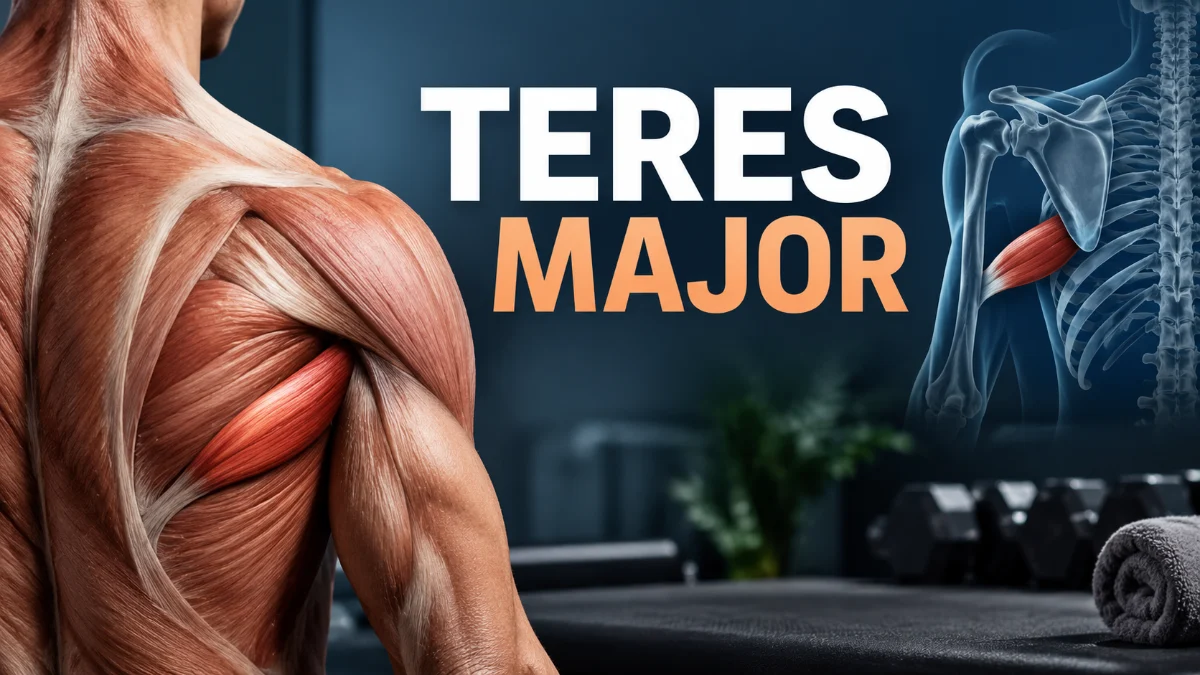
The teres major is a small but important muscle located at the back of the shoulder. It helps move the upper arm, particularly during movements that involve bringing the arm toward the body, rotating it inward, or moving it backward.
Although the teres major is sometimes confused with the nearby teres minor, these muscles have different attachments, nerve supplies, and functions. Another common misconception is that the teres major belongs to the rotator cuff. It does not. The four rotator cuff muscles are the supraspinatus, infraspinatus, teres minor, and subscapularis.
The teres major muscle works closely with the latissimus dorsi, which performs several similar actions at the shoulder. These muscles contribute to movements used during pulling, climbing, rowing, swimming, and some throwing activities.
Understanding teres major anatomy, function, origin and insertion, pain, injuries, stretches, and exercises can be useful for anatomy students, athletes, fitness enthusiasts, and anyone interested in shoulder function.
This comprehensive guide covers 10 essential facts about the teres major, including its location, origin, insertion, innervation, actions, potential causes of pain, injury symptoms, diagnosis, treatment, stretches, strengthening exercises, and frequently asked questions.
Medical Disclaimer: This article is for general informational and educational purposes only. It is not a substitute for professional medical advice, diagnosis, or treatment. Consult a qualified healthcare professional for severe, persistent, worsening, or unexplained shoulder pain or weakness.
Teres Major Quick Facts
| Feature | Information |
| Muscle | Teres major |
| Location | Posterior shoulder region |
| Origin | Inferior angle and adjacent lower lateral border of the scapula |
| Insertion | Medial lip of the intertubercular groove of the humerus |
| Primary Actions | Adduction, medial rotation, and extension of the arm |
| Innervation | Lower subscapular nerve |
| Nerve Roots | Commonly described as C5–C7 |
| Works Closely With | Latissimus dorsi |
| Part of Rotator Cuff? | No |
Read more: Teres Major
1. What Is the Teres Major?
The teres major is a thick, flattened muscle in the posterior shoulder region. It extends from the lower portion of the scapula, or shoulder blade, to the upper part of the humerus, or upper-arm bone.
Despite its relatively small size, the muscle contributes to several important movements at the shoulder joint.
Its principal actions include:
- Adduction of the arm
- Medial or internal rotation of the arm
- Extension of the arm
- Coordinated control of upper-arm movement
The teres major frequently works with the latissimus dorsi, particularly during pulling movements.
Where Is the Teres Major Located?
The teres major location is at the back of the shoulder near the lower portion of the scapula.
Its fibers extend from the scapula toward the proximal humerus. The muscle lies inferior to the teres minor and is closely related to the latissimus dorsi.
It also contributes to the posterior fold or wall of the axillary region.
Because several muscles, tendons, nerves, and joint structures occupy the shoulder region, pain felt near the teres major does not necessarily mean this muscle is injured.
Problems involving the rotator cuff, latissimus dorsi, shoulder joint, or other surrounding structures can sometimes cause discomfort in a similar location.
2. Teres Major Origin and Insertion
Understanding the teres major origin and insertion makes its function easier to understand.
Muscles create movement by producing force across their attachments. The position of the teres major between the scapula and humerus allows it to influence several movements of the upper arm.
Teres Major Origin
The teres major originates primarily from the posterior surface of the inferior angle of the scapula and the adjacent lower portion of the lateral border.
The scapula provides a relatively stable base from which the muscle can act on the humerus.
Teres Major Insertion
The teres major travels toward the upper arm and inserts on the medial lip of the intertubercular groove of the humerus.
Its insertion is closely related anatomically to the insertion of the latissimus dorsi.
When the muscle contracts, it can pull on the humerus and contribute to shoulder adduction, internal rotation, and extension.
3. What Is the Function of the Teres Major?
The teres major function primarily involves movement of the humerus at the shoulder joint.
Its three major actions are:
- Adduction
- Medial rotation
- Extension
These actions explain why the muscle becomes active during many pulling and upper-body movements.
Adduction of the Arm
Shoulder adduction means bringing the upper arm toward the body.
For example, imagine holding your arm away from your side and then pulling it downward toward your torso. The teres major can assist with this movement.
The latissimus dorsi and pectoralis major also contribute to shoulder adduction.
Internal Rotation of the Arm
Internal rotation, also known as medial rotation, occurs when the humerus rotates inward.
The teres major contributes to this action along with muscles such as the latissimus dorsi, pectoralis major, and subscapularis.
Internal rotation is involved in numerous everyday and athletic movements.
Extension of the Arm
The teres major can also assist with shoulder extension, particularly when the arm begins in a flexed or forward position.
Shoulder extension occurs when the upper arm moves backward from a forward position.
Pulling the arm downward from an overhead position can therefore involve the teres major together with several larger muscles.
Role in Shoulder Control
The teres major is not a rotator cuff muscle, so its role should not be confused with the specialized stabilizing function of the rotator cuff.
However, its coordinated activity with surrounding muscles can contribute to controlled movement of the upper arm during shoulder motion.
4. Teres Major Innervation and Blood Supply
Like other skeletal muscles, the teres major depends on nerve signals and an adequate blood supply to function.
Understanding its nerve supply is particularly important in anatomy.
What Nerve Innervates the Teres Major?
The teres major is innervated by the lower subscapular nerve, which arises from the posterior cord of the brachial plexus.
Its nerve-root contributions are commonly described as C5–C7, although anatomical descriptions can vary slightly.
The lower subscapular nerve can also supply part of the subscapularis muscle.
Teres Major Blood Supply
The teres major receives blood through vessels in the shoulder and axillary region.
Arterial contributions may include branches associated with the subscapular and posterior circumflex humeral arterial systems, with anatomical variation possible between individuals and references.
Blood flow delivers oxygen and nutrients needed for normal muscle function and tissue maintenance.
5. Is the Teres Major a Rotator Cuff Muscle?
No. The teres major is not part of the rotator cuff.
This distinction is particularly important because teres major is easily confused with teres minor.
The four rotator cuff muscles are:
- Supraspinatus
- Infraspinatus
- Teres minor
- Subscapularis
These muscles and their tendons play an important role in controlling and stabilizing the humeral head at the shoulder joint.
The teres major participates in shoulder movement but is anatomically separate from the rotator cuff.
Teres Major vs Teres Minor
Despite their similar names and nearby locations, teres major and teres minor are different muscles.
| Feature | Teres Major | Teres Minor |
| Part of Rotator Cuff | No | Yes |
| Primary Rotation | Internal rotation | External rotation |
| Innervation | Lower subscapular nerve | Axillary nerve |
| Humeral Insertion | Medial lip of intertubercular groove | Greater tubercle |
| Relative Location | Inferior to teres minor | Superior to teres major |
One of the easiest distinctions to remember is their effect on rotation.
The teres major assists internal rotation, whereas the teres minor assists external rotation.
6. What Causes Teres Major Pain?
Teres major pain may occur after excessive loading, overstretching, direct trauma, or sudden forceful movements involving the shoulder.
Isolated teres major injuries appear to be relatively uncommon compared with many other shoulder injuries.
Activities involving substantial shoulder extension, adduction, or internal rotation can potentially place stress on the muscle.
Examples include:
- Throwing sports
- Baseball pitching
- Rowing
- Swimming
- Climbing
- Racquet sports
- Heavy pulling exercises
- Sudden lifting
- Forceful overhead movements
- Rapid acceleration or deceleration of the arm
Pain after one of these activities does not automatically indicate a teres major injury.
What Does Teres Major Pain Feel Like?
Symptoms depend on the cause and severity of the injury.
Possible symptoms associated with an injury in the teres major region may include:
- Pain at the back or lower portion of the shoulder
- Tenderness near the posterior armpit
- Pain during pulling movements
- Discomfort with internal rotation
- Pain during throwing
- Pain during overhead activity
- Reduced strength
- Swelling following an acute injury
- Bruising with a more significant tear
These symptoms are not specific enough to diagnose a teres major injury on their own.
The rotator cuff, latissimus dorsi, shoulder joint, nerves, and other surrounding structures can cause pain in similar areas.
Persistent or significant symptoms therefore deserve appropriate medical assessment.
7. Teres Major Strain and Injury
A teres major strain can occur when muscle fibers are overstretched or torn.
Muscle strains are commonly described according to their severity, although an accurate diagnosis requires clinical assessment.
Grade 1 Muscle Strain
A mild strain involves relatively limited muscle-fiber damage.
Symptoms may include mild pain or soreness while much of the person’s normal movement and strength remain intact.
Grade 2 Muscle Strain
A moderate strain involves more substantial muscle-fiber damage.
Possible symptoms include:
- Increased pain
- Weakness
- Swelling
- Reduced movement
- Difficulty performing activities that load the injured muscle
Recovery requirements vary according to the extent of the injury.
Grade 3 Muscle Strain
A severe strain can involve extensive tearing or complete rupture.
Symptoms may include substantial weakness, swelling, bruising, and loss of normal function.
A suspected severe muscle or tendon injury requires professional medical evaluation.
Teres Major Injuries in Athletes
Teres major injuries have been described particularly in athletes involved in high-force throwing activities.
The muscle’s close functional and anatomical relationship with the latissimus dorsi is important when evaluating injuries in this region.
An injury may involve the teres major, latissimus dorsi, or nearby structures, making accurate diagnosis important before determining treatment and return-to-sport decisions.
8. How Is Teres Major Pain Diagnosed and Treated?
Many shoulder conditions can cause similar symptoms.
For this reason, determining whether pain actually originates from the teres major muscle may require assessment by a qualified healthcare professional.
Diagnosing a Teres Major Injury
A clinician may ask about:
- How the symptoms started
- Whether an injury occurred
- Location of pain
- Sports and exercise activities
- Movements that worsen symptoms
- Weakness or loss of movement
- Previous shoulder problems
A physical examination may assess shoulder range of motion, strength, tenderness, and movements that reproduce the symptoms.
When a significant muscle or tendon injury is suspected, imaging such as MRI may sometimes be considered to assess the soft tissues.
Treatment for Teres Major Pain
Treatment depends on the cause and severity of the problem.
Management of a minor muscular injury may involve temporarily reducing or modifying activities that aggravate symptoms.
As recovery progresses, a healthcare professional or physical therapist may recommend appropriate mobility and progressive strengthening exercises.
More substantial muscle or tendon tears require individualized assessment.
Not every teres major injury requires surgery. However, severe injuries—particularly in athletes with high performance demands—may require specialist evaluation.
When Should You See a Doctor?
Seek professional medical evaluation if shoulder pain is severe, persistent, worsening, or follows significant trauma.
Medical assessment is also important when symptoms include:
- Significant weakness
- Major swelling
- Extensive bruising
- Visible deformity
- Inability to move the arm normally
- Numbness or tingling
- Progressive loss of function
- Symptoms that do not improve as expected
Chest pain, difficulty breathing, or other potentially urgent symptoms should not be assumed to result from a shoulder muscle injury. Seek urgent medical care when appropriate.
9. Best Teres Major Stretches
A teres major stretch generally involves moving the shoulder in directions that lengthen the muscle.
Because the teres major contributes to adduction, extension, and internal rotation, certain overhead mobility movements may stretch the teres major along with neighboring tissues such as the latissimus dorsi.
It is difficult to completely isolate the teres major during stretching.
Stretching should feel controlled and comfortable rather than sharp or painful.
Overhead Side Stretch
Raise one arm overhead.
Slowly lean your upper body toward the opposite side until you feel a comfortable stretch along the side of the upper back or shoulder.
Avoid forcing the shoulder farther than feels comfortable.
Child’s Pose Reach
Begin in a comfortable kneeling position.
Reach both arms forward while gradually moving your hips backward.
To emphasize one side, gently reach the hands toward the opposite direction while maintaining a comfortable position.
This may stretch tissues around the latissimus dorsi and teres major region.
Bench Shoulder Stretch
Place both hands on a stable bench or another secure elevated surface.
Move your hips and torso backward while allowing your chest to lower gently.
Keep the movement controlled and stop if you experience pain.
How Long Should You Stretch?
There is no single stretching duration or routine that is ideal for every person.
For general mobility, stretching should remain comfortable and controlled. Avoid bouncing or aggressively forcing the shoulder into a greater range.
If you are recovering from an injury, follow the recommendations of your healthcare professional or physical therapist.
Avoid aggressive stretching of an acutely injured muscle.
10. Best Teres Major Exercises for Strength
Because the teres major contributes to shoulder extension, adduction, and internal rotation, many pulling exercises naturally recruit it.
The muscle generally works alongside larger muscles, particularly the latissimus dorsi, rather than functioning in isolation.
Attempting to completely isolate the teres major is usually unnecessary for general strength training.
Lat Pulldown
The lat pulldown involves pulling resistance downward from an overhead position.
Although the exercise primarily targets the latissimus dorsi, it also recruits muscles that assist shoulder adduction and extension, including the teres major.
Use controlled technique rather than excessive weight.
Pull-Ups
Pull-ups require substantial shoulder adduction and extension.
During the movement, the teres major can assist the latissimus dorsi and other muscles involved in pulling the body upward.
Proper technique and an appropriate progression are important, particularly for beginners.
Seated Rows
Rows strengthen several muscles of the back and shoulder.
During a controlled rowing movement, the upper arm moves backward, recruiting muscles involved in shoulder extension along with the muscles that control the shoulder blades.
Straight-Arm Pulldown
The straight-arm pulldown emphasizes shoulder extension as resistance is pulled downward from an elevated position.
The exercise can recruit both the latissimus dorsi and teres major.
Avoid excessive resistance that causes compensatory movement or shoulder discomfort.
Resistance-Band Shoulder Exercises
Resistance bands can provide adjustable resistance for shoulder extension, adduction, and rotational movements.
They may be useful when resistance needs to be introduced or progressed gradually.
However, exercises used during injury rehabilitation should be selected according to the individual’s condition and professional guidance.
Exercise Safety Tips
Safe shoulder training involves more than choosing the right exercises.
General principles include:
- Begin with manageable resistance.
- Use controlled movements.
- Maintain good exercise technique.
- Increase resistance and training volume gradually.
- Avoid forcing painful ranges of motion.
- Stop an exercise if it causes sharp or unusual pain.
- Allow adequate recovery between demanding sessions.
- Address persistent pain rather than repeatedly training through it.
People recovering from a diagnosed shoulder injury should follow an individualized rehabilitation plan.
Teres Major and Latissimus Dorsi
The relationship between the teres major and latissimus dorsi is important because the muscles share several actions.
Both can contribute to:
- Shoulder extension
- Shoulder adduction
- Internal rotation
Their fibers travel in similar directions near the upper arm, and their humeral attachments are anatomically close.
This functional relationship helps explain why both muscles may participate during pulling, climbing, rowing, and swimming.
However, they remain separate muscles.
The latissimus dorsi is a large muscle covering a substantial area of the back and is innervated by the thoracodorsal nerve.
The teres major is considerably smaller, originates from the scapula, and is innervated by the lower subscapular nerve.
Why Is the Teres Major Important?
The teres major muscle is smaller than major muscles such as the deltoid and latissimus dorsi, but it still contributes meaningfully to upper-arm movement.
It works with surrounding muscles during many everyday and athletic activities.
Examples include:
- Pulling a door toward the body
- Climbing
- Swimming
- Rowing
- Pulling an object downward
- Performing pull-ups
- Certain throwing movements
- Moving the upper arm backward
- Bringing an elevated arm toward the torso
The muscle is also anatomically important because of its relationship with the scapula, humerus, axillary region, latissimus dorsi, triceps, and nearby neurovascular structures.
How to Keep the Teres Major and Shoulders Healthy
No training strategy can prevent every shoulder injury.
However, balanced strength training, appropriate mobility, gradual progression, and adequate recovery can help manage unnecessary stress on the shoulder complex.
A balanced shoulder and upper-body program may include appropriate training for the:
- Rotator cuff muscles
- Deltoids
- Latissimus dorsi
- Scapular stabilizers
- Pectoral muscles
- Upper-back muscles
Training load should generally be increased progressively rather than suddenly, particularly in activities involving repeated throwing, swimming, climbing, or heavy pulling.
Good technique and adequate recovery are also important.
If a particular movement repeatedly produces pain, continuing to train aggressively through the symptoms may aggravate an underlying problem.
Persistent or worsening shoulder pain should be appropriately assessed.
Frequently Asked Questions
What Is the Teres Major?
The teres major is a muscle in the posterior shoulder region. It extends from the lower part of the scapula to the proximal humerus and helps produce several movements of the upper arm.
What Is the Function of the Teres Major?
The primary teres major functions are shoulder adduction, medial or internal rotation, and extension of the humerus.
It commonly works with the latissimus dorsi during pulling movements.
Where Is the Teres Major Located?
The teres major is located at the back of the shoulder near the inferior portion of the scapula.
It lies below the teres minor and extends toward the proximal humerus.
What Are the Origin and Insertion of the Teres Major?
The teres major originates primarily from the posterior inferior region of the scapula, including the inferior angle and adjacent lower lateral border.
It inserts on the medial lip of the intertubercular groove of the humerus.
What Nerve Innervates the Teres Major?
The teres major is innervated by the lower subscapular nerve, which arises from the posterior cord of the brachial plexus.
Is the Teres Major Part of the Rotator Cuff?
The teres major is not a rotator cuff muscle.
Teres minor is part of the rotator cuff along with the supraspinatus, infraspinatus, and subscapularis.
What Causes Teres Major Pain?
Potential causes of pain in the teres major region include overuse, overstretching, direct trauma, or forceful athletic movements.
However, pain in this area can originate from other shoulder structures. Symptoms alone cannot confirm a teres major injury.
What Exercises Work the Teres Major?
Exercises involving shoulder adduction and extension can recruit the teres major.
Examples include lat pulldowns, pull-ups, seated rows, straight-arm pulldowns, and certain resistance-band movements.
These exercises also recruit other muscles, especially the latissimus dorsi.
What Is the Difference Between Teres Major and Teres Minor?
Teres major primarily assists shoulder internal rotation, adduction, and extension and is not part of the rotator cuff.
Teres minor primarily assists external rotation and is one of the four rotator cuff muscles.
They also differ in their attachments and nerve supply.
How Long Does a Teres Major Injury Take to Heal?
There is no single recovery period for every teres major injury.
Healing time depends on factors such as the type and severity of the injury, whether muscle or tendon tissue is involved, the person’s activity demands, rehabilitation progress, and the treatment required.
A mild muscle strain and a substantial tear can have very different recovery timelines. A healthcare professional can provide a more individualized estimate after evaluating the injury.