
Custom transfer company Ninja Transfers aims to unlock the power of DTF (Direct-to-Film) transfers for anyone—including individuals, teams, print shops, apparel businesses, and others wanting to decorate clothing—without needing a full-fledged DTF printing setup.
After this, customers upload their artwork and order heat transfers that are ready to be printed—no need to purchase a DTF printer, control inks, apply adhesive powder, cure transfers, or troubleshoot the printing.
This is particularly useful for a small clothing business that wants to make custom wear available to customers with minimal production equipment and stock on hand.
In this guide, we will go over how Ninja Transfers operates, what DTF transfers and gang sheets are, artwork requirements, compatible fabrics, application, cost, durability, shipping and refund policies, advantages, limitations, and whether Ninja Transfers may work for your garments.
What Is Ninja Transfers?
Ninja Transfers is a US-based manufacturer of custom transfers for DTF and other heat-applied decoration products.
The service allows users to upload their digital art, choose the transfer size and quantity, and order printed transfers suitable for heat-press application on compatible garments.
Some of Ninja Transfers’ basic functionalities for its standard DTF service include:
- No minimum order
- No standard setup fee
- Custom artwork uploads
- DTF transfers by size
- Gang-sheet builders
- Upload-your-own gang sheets
- Specialty transfer options
- Heat-applied garment decoration
The items marketed as DTG use the company’s proprietary VIVID AF printing system.
Disclaimer: Product prices, specifications, shipping promotions, and policies are subject to change. Check the current information before ordering.
Read more: Ninja Transfers
Ninja Transfers at a Glance
| Feature | General Offering |
| Main product | Custom DTF transfers |
| Minimum order | No minimum advertised |
| Setup fees | No standard setup fee advertised |
| Art fees | No standard art fee advertised |
| Ordering options | Transfers by size, gang-sheet builder, gang-sheet upload |
| Preferred artwork | Vector when available |
| Raster recommendation | Around 300 DPI or higher |
| Fine-detail guidance | Minimum usable element around 0.02 in / 0.5 mm |
| Typical customers | Printers, creators, garment sellers, teams and individuals |
| Application | Heat and pressure |
| Standard DTF system | VIVID AF 9-color configuration |
| Refund/reprint policy | Check the current policy before ordering |
Ninja Transfers suggests using vector artwork when available and high-resolution raster images at the intended print size.
What Are DTF Transfers?
Direct-to-Film, or DTF, is a printing method in which artwork is printed onto transfer film and then applied to a garment using heat and pressure.
This differs from Direct-to-Garment printing, which prints directly onto the garment.
A DTF process looks like this at a high level:
Digital artwork → print to film → apply adhesive → cure → complete transfer → heat press onto garment
When ordering outsourced DTF transfers, most of the specialty printing work is already completed before the transfers reach you.
The customer mainly needs to:
- Prepare suitable artwork
- Choose the transfer size
- Select a quantity
- Place the order
- Prepare the garment
- Position the design
- Use the recommended temperature and pressure
- Peel and finish as directed
This outsourced workflow can reduce the technical requirements for businesses that want to decorate apparel without owning a full DTF printing operation.
How Does Ninja Transfers Work?
The basic process involves preparing your artwork, selecting the transfer details, placing your order, and applying the finished transfer to a garment.
Final quality depends heavily on both artwork and application, making preparation important.
Step 1: Prepare Your Artwork
Begin with the best-quality version of your design.
Vector artwork is often desirable because it can be resized without the sharpness loss associated with raster images.
If your design contains raster images, use high-resolution artwork properly sized for printing.
Avoid taking a small web image and enlarging it for a large shirt print. An image that looks acceptable at two inches wide may appear pixelated when stretched to ten or twelve inches.
Step 2: Select an Ordering Method
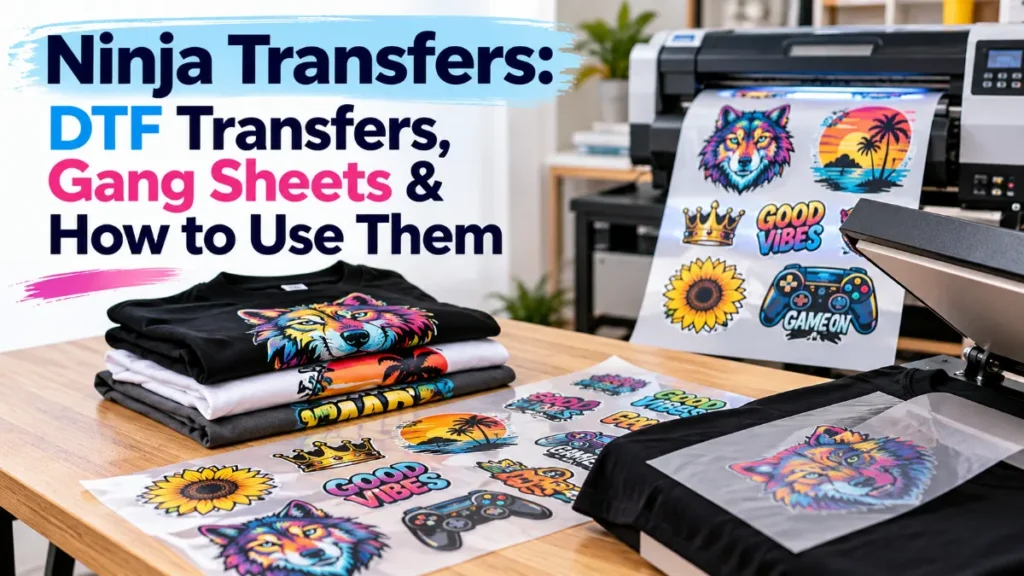
Ninja Transfers provides multiple ways to order DTF designs.
You may:
- Request transfers by individual size
- Build a gang sheet online
- Upload your own completed gang sheet
The most cost-effective option depends on the number of designs, dimensions, quantities, and how efficiently the available print area is used.
Step 3: Select the Transfer Size
Choose dimensions that suit the garment and intended design placement.
A small left-chest logo requires very different dimensions from a large full-front or back design.
For important garments or production runs, measure the actual garment before ordering.
Step 4: Choose the Quantity
Standard DTF transfers are advertised without a minimum order.
This can make the service useful for:
- Product samples
- One-off customer orders
- Test designs
- Prototype collections
- Small merchandise drops
- Limited releases
- Larger production runs
Step 5: Review Your Artwork
Proof your design carefully before checkout.
Check:
- Spelling
- Names and dates
- Logo version
- Image resolution
- Transparency
- Unwanted backgrounds
- Fine lines
- Finished dimensions
- Orientation
- Overall image quality
A printer may accurately reproduce the artwork you submit but may not know whether a name, number, date, or logo version is incorrect.
Step 6: Place the Order
Before completing checkout, verify the transfer size, quantity, shipping address, delivery option, and artwork.
Allow enough time for both manufacturing and carrier transit, particularly for deadline-sensitive projects.
Step 7: Apply the Transfer
Follow the current application instructions for the specific transfer product you purchased.
Different products may require different temperatures, pressure levels, pressing times, peel methods, and final-press requirements.
What Is a DTF Gang Sheet?
A DTF gang sheet is a large printable area containing multiple individual designs arranged together on a single sheet.
For example, a print shop could place the following on one gang sheet:
- Four left-chest logos
- Two large back prints
- Sleeve graphics
- Neck labels
- Customer names
- Small promotional designs
The goal is to utilize the available printable area efficiently instead of ordering each graphic separately.
Reducing Cost per Transfer With Gang Sheets
If multiple transfers fit efficiently in the available print area, gang sheets can lower the effective cost per design.
A simple calculation is:
Approximate transfer cost = Gang-sheet cost ÷ Usable transfers
For example, if a gang sheet costs $30 and contains 20 usable logos:
$30 ÷ 20 = $1.50 per logo
This calculation helps apparel businesses compare gang sheets with individually priced transfers.
However, wasted space, shipping, labor time, unusable designs, and production errors can affect the actual cost per transfer.
Ninja Transfers Artwork Requirements
Good artwork is one of the most important factors in obtaining clean DTF results.
Use Vector Artwork When Possible
Vector graphics rely on mathematically defined paths rather than pixel grids.
They are especially useful for:
- Logos
- Lettering
- Illustrations
- Icons
- Shapes
- Brand graphics
Vector graphics are generally scalable while retaining crisp edges.
Use High-Resolution Raster Images
Raster graphics consist of pixels, so enlarging a low-resolution image can create visible pixelation and blurry edges.
A file suitable for a small left-chest logo may not contain enough detail for a large full-back print.
Resolution should therefore be evaluated at the final print dimensions.
Avoid Extremely Fine Details
Very small design elements may not transfer reliably.
Pay particular attention to:
- Tiny text
- Hairline strokes
- Small dots
- Thin borders
- Fine decorative details
Use Transparent Backgrounds Correctly
If your design is intended to have no background, verify that unwanted areas are actually transparent.
Otherwise, an unwanted box or background may appear in the finished print.
Check the Final Print Dimensions
An image appearing sharp on a smartphone or computer screen does not necessarily mean it will remain sharp when printed at a larger size.
Always evaluate the artwork at its intended print dimensions.
Which Fabrics Can Be Used With Ninja Transfers?
DTF transfers are designed to work with a range of common garment fabrics, including cotton, polyester, and blends.
Potential applications include:
- Cotton T-shirts
- Polyester apparel
- Cotton-polyester blends
- Hoodies
- Sweatshirts
- Tote bags
- Denim
- Sportswear
- Workwear
- Other compatible textiles
Broad compatibility does not mean every garment should be pressed under identical conditions.
Additional care may be needed with:
- Heat-sensitive fabrics
- Waterproof or coated textiles
- Highly stretchy garments
- Lightweight materials
- Delicate fabrics
- Specialty performance textiles
Test unfamiliar garments before committing to a complete production run.
How to Apply Ninja Transfers
Ninja Transfers are applied using controlled heat and pressure according to the instructions for the particular product.
Print quality is not the only factor affecting adhesion, appearance, and durability. Application quality is also important.
Prepare the Garment
Place the garment flat and provide a surface that allows even pressure.
Avoid positioning transfers over seams, collars, pockets, zippers, or buttons that could interfere with pressure.
Position the Transfer
Make sure the design is aligned correctly before pressing.
For larger production runs, rulers, placement guides, and templates can help maintain consistent positioning.
Apply Heat and Pressure
Use the recommended:
- Temperature
- Pressure
- Press time
Do not assume that settings from another DTF provider or transfer type will work correctly.
Peel as Directed
Follow the peel instructions for the transfer product you ordered.
The system may require a hot, warm, or cool peel.
Complete the Final Press
After removing the film, a final press may be recommended.
Always follow the current transfer instructions rather than relying on settings from a previous product or order.
Is a Heat Press Required for Ninja Transfers?
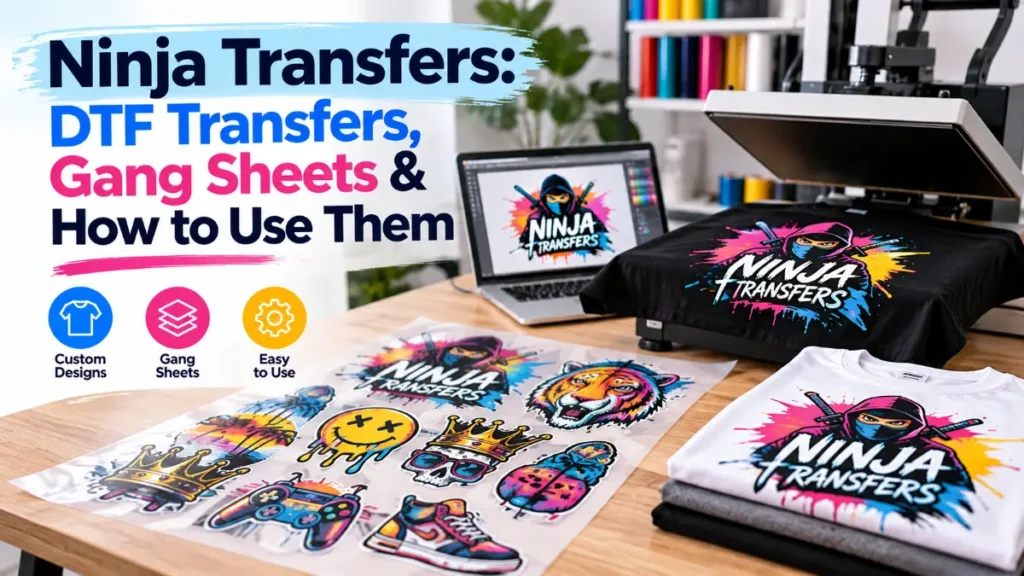
A commercial heat press will generally be the most practical option for repeatable quality in a production environment.
A heat press provides control over:
- Temperature
- Pressure
- Contact area
- Timing
- Repeatability
Other heating tools may work for some applications, but businesses fulfilling paid customer orders may benefit from the consistency provided by a quality heat press.
Ninja Transfers vs. Screen Printing
DTF can be versatile for smaller quantities, multicolor artwork, and designs requiring frequent changes. Screen printing can be efficient for larger runs of repeated, relatively simple designs.
| Factor | DTF Transfers | Screen Printing |
| Small quantities | Very practical | Setup may be inefficient |
| Multicolor designs | Strong option | May require additional setup |
| Gradients | Well suited | More specialized |
| One-off designs | Convenient | Usually less practical |
| Large simple runs | Competitive | Often highly efficient |
| Equipment | Primarily heat press for application | Full printing setup |
| Design changes | Fast | Screens may need changing |
| Personalization | Convenient | Less practical for many unique pieces |
DTF flexibility may suit online stores with low-volume orders, multiple designs, and uncertain demand.
Screen printing may be more cost-effective when producing thousands of pieces featuring the same simple graphic.
Ninja Transfers vs. HTV
DTF works well for detailed multicolor graphics, while Heat Transfer Vinyl can be suitable for simple lettering, names, numbers, and basic logos.
HTV Commonly Works Well For
- Names
- Jersey numbers
- Basic lettering
- Simple logos
- Single-color graphics
DTF Is Useful for Designs With
- Multiple colors
- Gradients
- Illustrations
- Fine details
- Complex logos
- Mixed graphic elements
Creating a full-color illustrated design with multiple layers of HTV can be time-consuming, while DTF can combine the design into a single printed transfer.
Ninja Transfers vs. DTG Printing
DTF uses transfer film, while DTG prints ink directly onto the garment.
This difference can affect inventory management.
DTF transfers can be produced and stored separately from blank garments. A seller can keep blank shirts in different sizes and apply designs after orders are received.
DTG, by comparison, generally involves printing directly onto the finished garment.
Keeping transfers separately from blank garments can provide flexibility for smaller sellers offering many designs and sizes.
Products Offered by Ninja Transfers
Ninja Transfers provides standard DTF and various specialty transfer products.
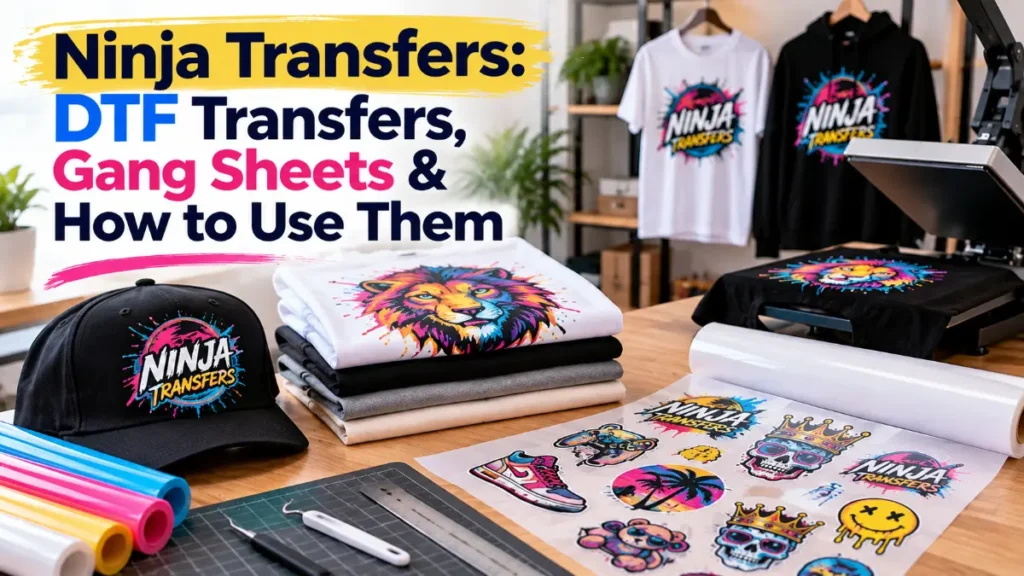
Its catalog may include:
- Standard DTF transfers
- DTF gang sheets
- Glitter transfers
- Puff transfers
- Spangle transfers
- Gold foil transfers
- Silver foil transfers
- Glow-in-the-dark options
- Names-and-numbers gang sheets
- Other specialty transfer products
Lead times, availability, specifications, and application requirements depend on the product.
VIVID AF DTF Printing
Ninja Transfers also manufactures VIVID AF, a branded expanded-color DTF printing system.
The company markets the system around factors such as:
- Color saturation
- Gradients
- Detail
- Color matching
- Overall print vibrancy
These are manufacturer claims rather than independent laboratory comparisons.
Businesses requiring accurate brand-color reproduction should consider ordering samples and testing them before committing to a large run.
How Durable Are Ninja Transfers?
Print longevity depends on both transfer quality and correct application.
Real-world durability can be influenced by:
- Fabric
- Press calibration
- Temperature
- Pressure
- Press time
- Washing method
- Detergent
- Drying method
- Garment stretch
- Wear frequency
- Correct application
Commercial sellers should perform their own wash tests before making durability guarantees to customers.
Ninja Transfers Shipping Methods and Delivery Windows
Production and shipping times may vary by product, order conditions, shipping method, and destination.
Avoid assuming one turnaround estimate applies to every order.
A useful planning formula is:
Delivery Window = Production time + Carrier transit time + Contingency time
Possible delays can result from:
- Holidays
- Weather
- Carrier issues
- High order volume
- Artwork problems
- Address issues
If you have a fixed event or client deadline, ordering early provides additional protection against unexpected delays.
Ninja Transfers Shipping Costs
Shipping costs vary according to order value, destination, and the service selected at checkout.
Free-shipping promotions or minimum-order thresholds may sometimes be available and can change.
If your purchase depends on a promotion or discount, verify the final shipping price during checkout.
Ninja Transfers Refunds and Reprints
Check Ninja Transfers’ current refund and reprint policy before relying on a particular deadline or remedy.
Refund or reprint eligibility may depend on:
- Print defects
- Adhesion problems
- Artwork quality
- Customer-upload errors
- Time since delivery
- Product type
- Supporting evidence
Review the current policy before placing an important or time-sensitive order.
Advantages of Ninja Transfers
The main advantage of outsourcing transfers is getting ready-to-press products without operating the complete DTF printing process yourself.
No DTF Printer Required
A complete DTF workflow can involve:
- Printing hardware
- Specialized inks
- Transfer film
- Adhesive powder
- Curing equipment
- Maintenance supplies
- Ventilation
- Workspace
- Color-management knowledge
- Troubleshooting experience
Outsourcing can remove much of this operational burden from the printing stage.
Low Barrier to Testing Designs
No-minimum ordering can allow sellers to test products without committing to large quantities.
It can also help validate a product before scaling production.
Suitable for Complex Artwork
DTF can be useful for designs containing:
- Multiple colors
- Gradients
- Illustrations
- Detailed graphics
- Complex logos
- Mixed design elements
More Flexible Inventory
Sellers can keep blank garments and transfers separately instead of maintaining every design-and-size combination as finished inventory.
Gang-Sheet Efficiency
Organizing multiple designs efficiently on gang sheets can help reduce transfer costs for businesses that need numerous smaller graphics.
Potential Limitations of Ninja Transfers
Outsourcing can reduce production responsibilities, but it also introduces tradeoffs.
Supplier Dependence
Your production workflow depends on another company printing and shipping the transfers.
Shipping Affects Production Planning
Finished garments cannot be completed until the required transfers arrive.
Heat-Sensitive Garments Require Care
Some fabrics and coatings may be damaged by excessive temperature or pressure.
Large Prints Can Affect Feel
A large, solid transfer may feel denser than a smaller or more open design.
Artwork Quality Still Matters
DTF printing cannot restore detail that is absent from the original artwork.
A low-quality source image can still produce a poor result.
Is Ninja Transfers Good for Small Businesses?
Ninja Transfers can be useful for small apparel companies that offer multiple designs but do not want to invest in their own DTF printer or hold large quantities of finished garments.
For example, consider a clothing business with:
- 15 designs
- 5 garment sizes
- 10 preprinted shirts for every design-and-size combination
That would require:
15 × 5 × 10 = 750 finished shirts
Holding 750 finished units creates significant inventory exposure.
An alternative is maintaining a smaller inventory of blank apparel and transfers, then decorating garments as orders arrive.
This does not eliminate inventory risk, but it can reduce the number of finished design-and-size combinations a seller must stock.
How to Find Your True Cost per Shirt
Avoid judging profitability by transfer price alone. Calculate the complete production cost for each item.
A more realistic formula is:
True Unit Cost = Blank + Transfer + Prorated inbound shipping + Labor + Supplies + Packaging + Platform/payment fees + Anticipated waste
For example:
| Expense | Example Cost |
| Blank shirt | $4.50 |
| Transfer | $2.00 |
| Allocated inbound shipping | $0.40 |
| Labor | $1.50 |
| Packaging | $0.60 |
| Platform/payment costs | $2.00 |
| Estimated total | $11.00 |
In this hypothetical example, the product costs approximately $11 before advertising, returns, taxes, overhead, and profit.
That figure provides more useful business-planning information than considering only the transfer price.
Who Is Ninja Transfers Best For?
Ninja Transfers may suit customers who need custom transfers without wanting to manage the entire printing process themselves.
Potential users include:
- Custom T-shirt businesses
- Print shops
- Apparel startups
- Etsy sellers
- Marketplace sellers
- Schools
- Sports teams
- Corporate merchandise suppliers
- Event organizers
- Creators
- Influencers
- Small clothing labels
- Craft businesses
- Promotional-product businesses
- People making personalized gifts
The service is particularly relevant when flexible, lower-volume production matters more than controlling every part of the printing workflow.
How to Get Better Results With DTF Transfers
Proper artwork and controlled application can help produce more consistent DTF results.
For better production consistency:
- Upload the cleanest artwork available
- Use vector files when possible
- Use sufficient raster resolution
- Avoid microscopic details
- Measure transfer sizes physically
- Proofread every design
- Test unfamiliar garments
- Follow current application instructions
- Verify heat-press temperature
- Maintain consistent pressure
- Perform sample wash tests
- Record successful settings
- Inspect finished items before shipment
Commercial printers can also maintain a simple quality-control log.
What to Record in a Quality-Control Log
Record:
- Blank garment brand
- Fabric composition
- Press temperature
- Time
- Pressure
- Peel method
- Final-press method
- Wash-test results
This can turn trial and error into a more repeatable production process.
Common Ninja Transfers Mistakes to Avoid
Artwork problems, incorrect sizing, unsuitable press settings, and insufficient testing can contribute to preventable DTF problems.
Uploading Low-Resolution Artwork
Enlarging a small JPEG does not restore missing image detail.
Use the highest-quality source file available.
Ordering Without Measuring
A graphic that appears appropriately sized on a computer screen may look too large or too small on the actual garment.
Measure before ordering.
Ignoring Fine Details
Extremely thin lines and small design elements may create transfer reliability problems.
Using Incorrect Press Settings
Always follow the application instructions for the specific transfer product being used.
Ignoring Garment Limitations
Even a good transfer cannot prevent heat damage if a garment is unsuitable for the required application conditions.
Skipping Sample Testing
Producing and washing a single test garment can help identify problems before a larger production run.
Promising Deadlines Too Aggressively
Include production time, carrier transit time, and additional contingency time when setting customer deadlines.
Is Ninja Transfers Worth It?
Outsourced DTF production through Ninja Transfers may be worth exploring when its combination of cost, flexibility, quality, and convenience fits your production requirements better than printing transfers yourself.
It may be suitable when you:
- Need low-quantity custom transfers
- Frequently introduce new designs
- Want full-color artwork
- Do not own a DTF printer
- Need gang-sheet flexibility
- Want to focus on pressing and fulfillment
- Want to reduce finished-garment inventory
It may be less appealing if you already operate efficient high-volume printing equipment or another application method better suits the garment, artwork, or order volume.
Instead of asking only, “Is DTF good?”, consider a more practical question:
Would outsourced DTF provide the right balance of quality, cost, speed, flexibility, and control for this particular job?
Frequently Asked Questions
What Is Ninja Transfers?
Ninja Transfers is a custom-transfer supplier offering DTF transfers and other heat-applied products for apparel decoration.
What Does DTF Mean?
DTF stands for Direct-to-Film. Artwork is printed onto transfer film, prepared with adhesive, and then transferred to compatible clothing using heat and pressure.
Does Ninja Transfers Have a Minimum Order Requirement?
Standard DTF transfers are advertised without a minimum order, which can make them useful for one-off designs, prototypes, small clothing runs, and larger orders.
What Artwork Resolution Is Recommended for Ninja Transfers?
Vector artwork is useful when available. Raster images should be high resolution at their intended print dimensions, with around 300 DPI commonly recommended.
What Is a Ninja Transfers Gang Sheet?
A gang sheet combines multiple designs into one larger printable area. This can make it easier to organize logos, names, labels, sleeve graphics, and other designs efficiently.
Can Ninja Transfers Be Used on Cotton and Polyester?
DTF transfers can generally be used with common materials such as cotton, polyester, and blends. Sensitive, coated, or specialty materials should be tested before full production.
Do You Need a Heat Press for Ninja Transfers?
A commercial-grade heat press is generally the most consistent option because it provides better control over temperature, pressure, contact area, and pressing time.
How Long Do Ninja Transfers Last?
Durability depends on factors such as the fabric, transfer, design, press settings, application quality, washing method, drying method, and garment use. Commercial sellers should conduct their own wash testing before making durability claims.
What Is the Ninja Transfers Refund and Reprint Policy?
Refund and reprint eligibility can depend on the type of problem, product, artwork quality, supporting evidence, and time since delivery. Check the company’s current policy before placing an important order.
Is Ninja Transfers Good for a T-Shirt Business?
It may suit T-shirt businesses that want outsourced DTF transfers without investing in their own DTF printer. The model can support short runs, multiple designs, product testing, gang-sheet production, and a more flexible approach to finished-garment inventory.